
Psychotic Grandeur of Hubris, the Ninth Sin in Materiality
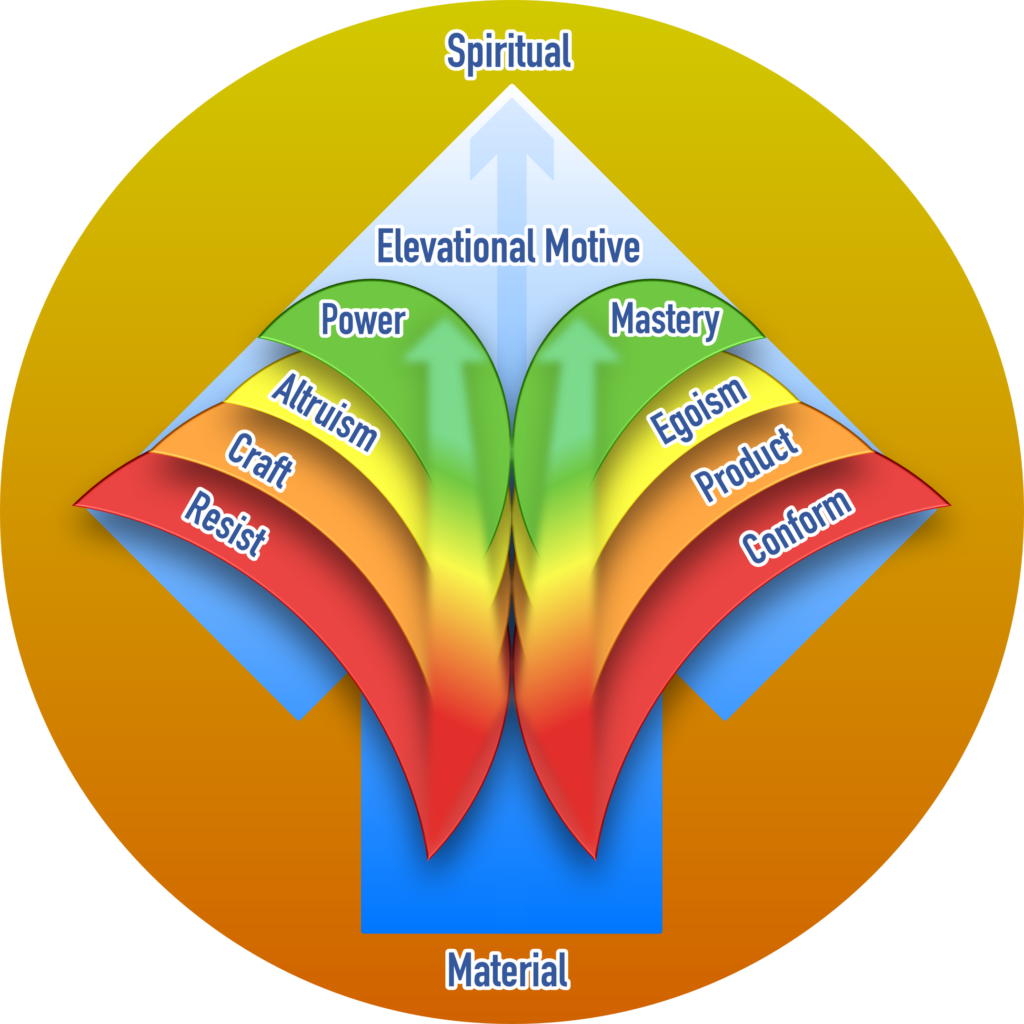
Power <-> Mastery
EROS (yellow):
Altruism <-> Egoism
TELOS (oranges):
Craft <-> Product
KRATOS (red):
Resist <-> Conform
In the third domain of Resurrexit Spiritus (RS), Eros, where relationships ripen in mutual trust, based upon stability through moderation’s strengths, or exploited in trade for illusions of power; the error of Hubris is a corrosive force against both sides: self or other. This is the systematic failure of Honesty’s face on reason through the Fear moment in the Conceit aspect of Materiality. Here in Hubris, the soul seeks to elevate itself above others, showing only loyalty to the lowest portion of selfness, through arrogance and self-righteousness, creating a cycle where reliance on personal superiority becomes a crutch made out of extraction (variously) with excuses. In Good Will Hunting, this sin is enforced by the institutionalised neglect of Will Hunting’s past, which fuels his destructive pattern of isolation and defiance, steeped in hubris backed by superiority. The lack of Willpower in preceding generations (Will’s foster father’s abuse, real family’s absence, and the consistent failure to help address childhood trauma by anyone remaining in his life; preferring the company of those who ask fewest serious questions) fuels his Conceit straight through Obsession, Disdain, and Amnesis, as he builds a fortress of pride around his wounds rather than confronting the past and his inordinate pride.
In Structural Virtues Theory (SVT), Hubris directly opposes Loyalty, which resides in the Honesty aspect under the Spirit moment (God’s Love). Loyalty is the virtue that allows us to recognise the inherent worth of others, even those we disagree with. Hubris, however, is its antithesis: it is the refusal to acknowledge the value of others, leading to cycles of disdain and suffering alone. The primary means we have of fighting Hubris is with the overarching moderation to be found in Temperance, as the Honesty virtue tied to order and Propriety.
Hubris is founded upon Amnesis, Disdain, and Obsession. This sin is an often self-denied aggrandisement of the lower self, like a lock completely blinded to its key. Conquering hubris requires the cultivation of Temperance and all its attendant restraint.
To conquer Hubris, one must first recognise the illusion of blind superiority. This involves interrogating the motivations behind arrogance: are they not rooted in fear, desire for control, or a need to dominate? Temperance, as the virtue which allows the conquering of Hubris, demands humility and greater levels of moderation.
In community, Hubris breeds division. When individuals elevate themselves above others, they create a culture of mistrust and engendered destructive internal competition. Overcoming such organisational trauma requires, just as with individuals, Temperance, where decisions are made with care and integrity in moderation. Hubris is deconstructed through disciplined decision-making and action leading to progress. Haughtiness cannot withstand real experience in improvement.
Machinery of Control
Will Hunting’s journey begins with his Hubris, a reliance upon a certain type of intellectual superiority to validate the self, rooted in Obsession and Disdain. His foster father’s abuse and abandonment left him with a deep-seated fear of being vulnerable blocking and development of deeper layers of trust, which he masks with arrogance and a basic off-handed stance maintained with everyone. He mocks therapists, sabotages job opportunities, and keeps everyone at arm’s length with sarcasm and bravado, because deep down his pride won’t let him risk real vulnerability or failure. His Amnesis is the refusal to confront the trauma of his past or the consequences of his actions in the now, a self-protective mechanism that prevents him from seeing the value in genuine human connection. He insults everyone and anyone that tries to recognise his humanity or his needs, out of this sheer pride.
The collapse of Hubris begins when Temperance emerges as the virtue targeting it with an institution of earned material humility; being the multi-faceted layering weaving through all the virtues. Temperance, which resides in the Honesty aspect under the Propriety moment, eventually allows Will Hunting to recognise the limitations of his intellectual superiority and see the worth in others. This process of ego shift is catalysed by the patient Dr. Sean Maguire, Will’s psychologist who challenges his defence mechanisms and forces him to confront truths about himself, his trauma, and his family, but then even Sean has limits. Will is used to eventually being disappointed by everyone that comes into his life. Everything for Will is about some underlying competition: “getting over on” before others get the better of you, prematurely before they can even defy expectations. The point of rejecting beneficial and serious friendship or a chance at love was immaturely founded upon this ignorant competition and expectation. This was all out of pure hubris, and can never be overcome until there is a vast reconsideration: of past situations and extremes in life, generally and particularly. Hubris grants only false loyalties, first overflowing to the lower self, then to others as hubristic and unserious at best, with full rejection of all real loyalties at worst as seen in the case of Will.
As Sean said, “You don’t know about real loss ’cause that only occurs when you love something more than you love yourself. I doubt you’ve ever dared to love anybody that much. I look at you, I don’t see an intelligent, confident man. I see a cocky, scared-shitless kid.” Indeed Will’s problems do stem from the Fear moment in the Conceit aspect of Materiality; “scared-shitless” and “cocky.” In their weekly therapy sessions, Sean gradually chips away at Will’s falsely aligned pride and the terror behind it, using various techniques to break through his self-imposed isolation “in supremacy.” Sean spoke Will’s language, most importantly at first, but it was his Loyalty that impressed Will more. Will sees in Sean something (beyond the material and “getting it over on the other” or “getting the better” side of any given situation), actually worthy of a righteous jealousy.
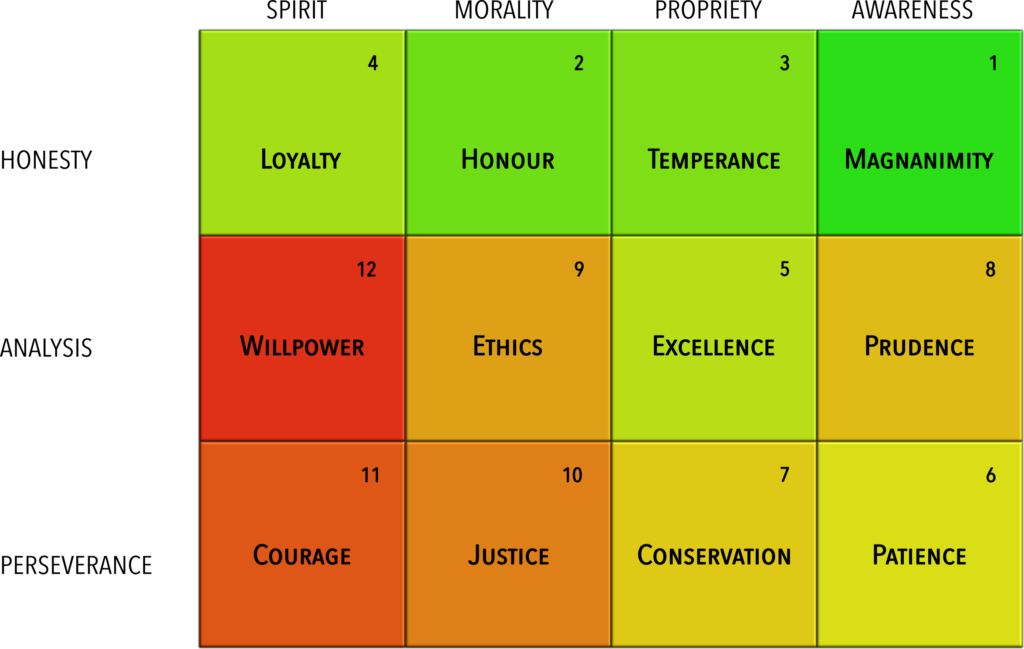
Virtues Chart
| Aspect > / Moment V | Honesty | Analysis | Perseverance |
|---|---|---|---|
| Awareness | Magnanimity | Prudence | Patience |
| Propriety | Temperance | Excellence | Conservation |
| Morality | Honour | Ethics | Justice |
| Spirit | Loyalty | Willpower | Courage |
Fall of Hubris and Rise of Temperance
The collapse of Hubris is the onset of true value in honest Loyalty, which provides us with the most honest of purposes beyond ourselves. Will’s quest in Temperance is marked by opportunities for self-restraint’s expression, emotional awareness, and humility to admit his psychological wounds instead of weaponising them. This temperate moderation is strengthened in growing Magnanimity (the ability to forgive himself for his past failures; initiation of identity) and Honour (recognition that true value is in a greater integrity; a fastening of identity). Magnanimity is also enabled by the Willpower of the preceding generation, embodied in Sean’s unwavering commitment to helping Will heal.
The film’s pivotal scene, the bench conversation where Sean repeatedly tells Will “It’s not your fault” symbolises the collapse of Hubris, ego and pride in false selfness and incorrect perspective of the image in self, which creates the space necessary for Loyalty, which is to say, ultimately, the Love of God Himself. This moment forces Will to confront his past trauma and recognise that his isolation was not a choice but the consequences of systemic neglect and abuse. His growing temperance allows him to reconsider his identity, his honour, and ultimately liquidate the false limitations thrust upon him by his own self-imposed reliance on a sense of superiority.
The Dawn of Loyalty
The fall of Hubris gives rise to Loyalty, which is the virtue opposing it. Loyalty, in SVT, is the completion of Honesty strengthened by Temperance, Honour, and Magnanimity. It is the recognition that true purpose cannot possibly be in self-aggrandisement but in service to others and greater good. Loyalty in Good Will Hunting is most evident in Will’s decision to commit to Skylar, his romantic interest, and reconcile with his South Boston “family” of friends. These choices represent a shift from the isolation of his past to the interconnectedness of the present. His growing loyalty is also reflected in his relationship with Sean, who becomes something of a father figure in his unwavering support.
The Birth of Excellence
The collapse of Hubris and the rise of Temperance and Loyalty enable the greater birth of Excellence, the first virtue acquired in the Analysis aspect after Loyalty, the crowning virtue in Honesty which is beyond Envy. Excellence is the recognition of the even higher value, not for the hubristic comparison to others but in the cultivation of one’s own potential which kicks into high-gear upon recognition of Excellence in others. This realisation apparently never happened for Will’s foster father, who abandoned him; it arrives just in time through Sean though, whose willpower and patience frame the transformation for Will’s greater conception of things, achieving a late greater improvement in socialisation through this alloparental and therapeutic bond.
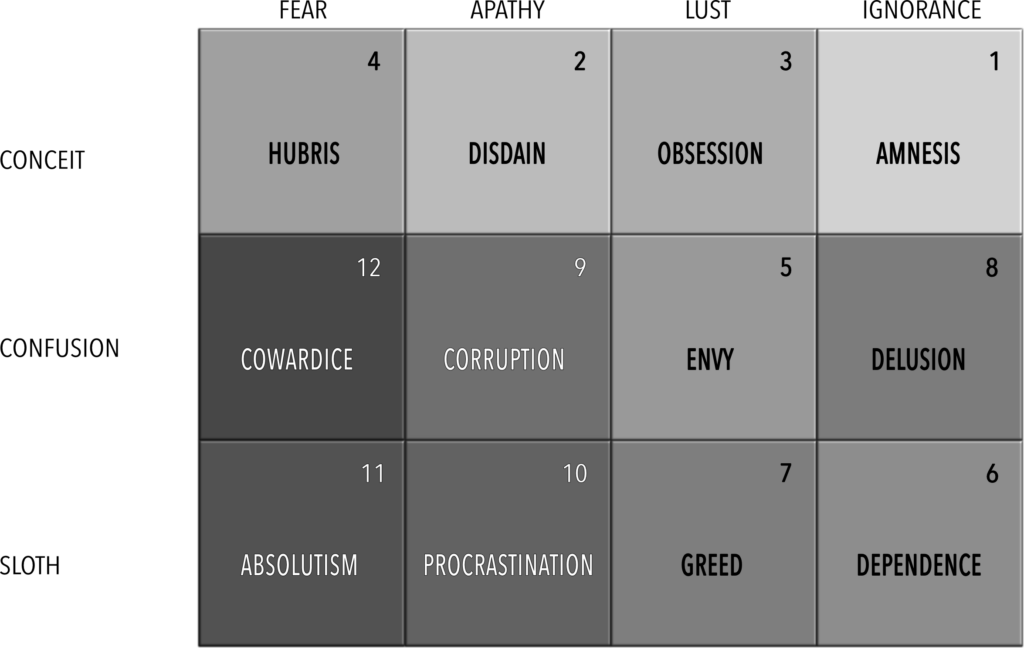
Sins Chart
| Aspect > / Moment V | Conceit | Confusion | Sloth |
|---|---|---|---|
| Ignorance | Amnesis | Delusion | Dependence |
| Lust | Obsession | Envy | Greed |
| Apathy | Disdain | Corruption | Procrastination |
| Fear | Hubris | Cowardice | Absolutism |
Excellence, as the virtue opposed to Envy, demands not only the non-hubristic ability to recognise achievements of others but also the understanding in spirit, in God’s Love, to forgive ourselves our own imperfections, our own sins we have committed. This honest and expansive Loyalty into Excellence then Patience is perhaps the strongest bridge between self-awareness, self-improvement, and collective progress. Such a bridge allows individuals to rise together above their difficulties and contribute meaningfully to society, instead of striving to be that critical outside third-party in some pretended attempt at an off-handed supremacy.
The Bridge to Patience
Finally, the onset of Excellence past Hubris gives birth also to Patience, the first virtue acquired in the Perseverance aspect after Excellence. Patience is the ability to accept delays without despair, recognising that true growth requires time and effort. This patience beyond dependence would have required Will to abandon his obsession with superiority, failure, or inferiority and focus instead on further cultivating his own artistry or connections with other artists, and who knows what else. He moves from never being willing to ante up and play the game to going all in.
Will drives off not to conquer the world with his gifts, nor in order to feed and serve his ego but to live in love with belonging. Like so many taken in by the false treasures of the world, the character surely still struggles with Hubris, though he may have caught on enough to remain Loyal long enough to bridge the other virtues. Furtherance of Excellence only comes from what we can best recognise in others, not just in their faults nor simply our own talents.
Leave a Reply