
Greed, Dependence, and Envy Aborting Rather Than Prudence and Ethics Birthing Truth
In the first domain of RS, Kratos, societies define themselves through the acceptance or rejection of rules, and the powers these rules have, especially when it comes to balance in the other proceeding domains. In There Will Be Blood (2007), this is embodied by Daniel Plainview’s manipulation of others, justified by Delusions, a sin operating against Kratos. His rise to wealth is built on the systematic erasure of Truth through lies and orchestration of chaos, then the efficient and often quiet subjugation of those who stand in his way. The rules he creates for himself and others are for control rather than anything approaching Justice: he overrides ownership, fabricates narratives, and exploits dependencies to maintain his Delusional sense of control.
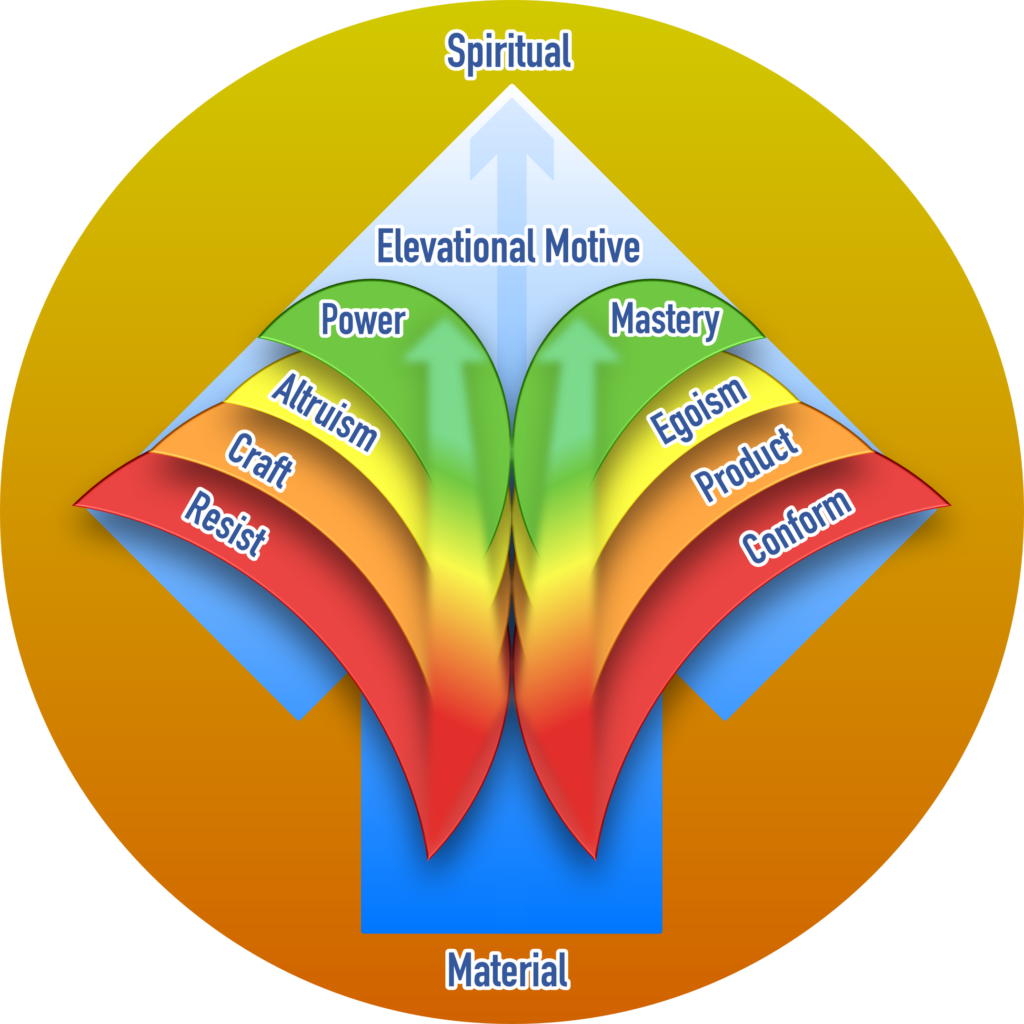
Power <-> Mastery
EROS (yellow):
Altruism <-> Egoism
TELOS (oranges):
Craft <-> Product
KRATOS (red):
Resist <-> Conform
When we begin to control our Greed (in SVT which compliments RS), Conservation (strengthened by Patience, Excellence, Loyalty, and Temperance) becomes the only path toward respite from Delusion and the clarity required to see Truth. And once Delusion collapses, it gives birth to Prudence, the second virtue of the Analysis aspect, which together with Excellence, becomes the bedrock for Ethics and finally Willpower. It is worth noting that Conservation is the most paternal of virtues whereas Prudence is the most maternal.
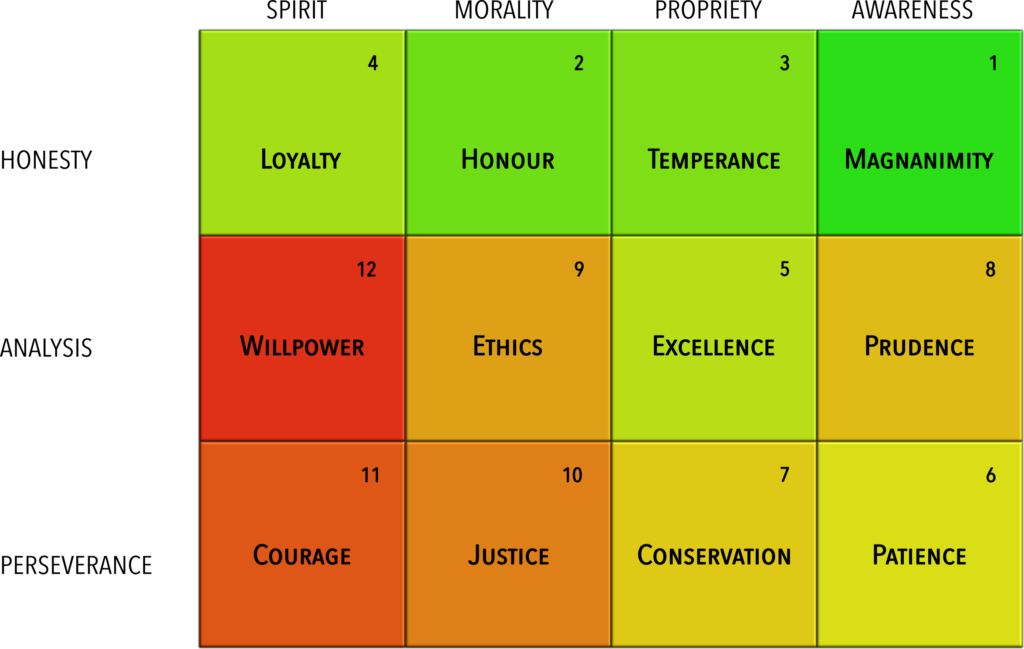
Daniel’s first act of Delusion is rooted in Greed, which fuels his obsession with wealth at the expense of all else, even his health. He discovers silver in New Mexico, despite breaking his leg while digging for it. This accident becomes something of the justification for the rest his descent into Delusional materialism. Greed, while stemming from Delusion, also strengthens it, as blinding to the moral cost of actions, compelling us to believe that wealth is the only measure of worth.
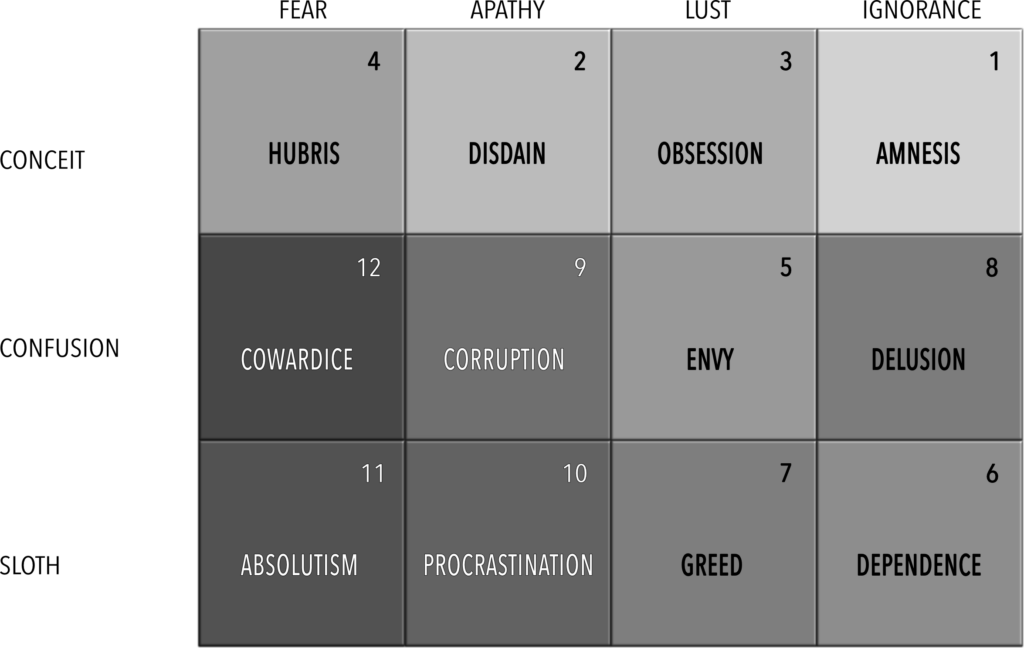
This delusion is further entrenched by Dependence. He adopts H.W., not out of love or duty but to exploit the child’s vulnerabilities for the purposes of sympathy, masking his identity and actual purposes. This dependence of the child mirrors his own, not merely as Dependence on others but on flawed notions: he depends on his own delusions to justify his actions, in believing that his wealth is the only purpose.
Methods in Extremity
The setter of rules must balance goals and outcomes with the processes and methods necessary to achieve them. Daniel’s goal is wealth in the extreme, vile avarice, an extreme only balanced by a match in equally extreme methods of manipulation and exploitation. He uses Paul Sunday’s land as a means to secure oil rights that drew surreptitiously on those of other properties, and when obstacles arose, like Eli’s refusal to sell or William Bandy’s resistance, he used violence and deceit to maintain control.
The film reveals how Delusion thrives against this domain of rules: the process becoming a tool for erasing truth, while the product, a false sense of success, is celebrated as expressions of divine favour rather than rapacious extraction. When H.W. is deafened and sent away, or when Eli is humiliated and killed, these events are not seen as failures but as necessary and quite acceptable sacrifices in the pursuit of profit. This is what happens in Telos in Delusion: the product becomes an illusion, while the process is a means to perpetuate it. The extremity of balances conveys the depth of the originating evil.
Forfeiture of Connection
The most insidious form of Delusion operates in the Eros domain, where relationships are not built on trust but on manipulation. Daniel’s interactions with H.W., Paul, and Eli are all marked by a lack of genuine connection. He sees them as tools rather than individuals, using their vulnerabilities to advance his own agenda. This is not mere exploitation; it is the cultivation of dependency through false promises and emotional manipulation.
Daniel’s relationship with H.W. is a prime example of this delusion. By adopting the boy, he creates an illusion of being a family man, but in reality, H.W. is another means to his ends. When H.W. seeks independence, Daniel responds with indignant and hateful anger with feelings of betrayal like a child’s. It was always about his own desires being perceived as needs, revealing the depths of his materialism in the minimisation of H.W.’s needs into nonsense and pleasantry. This is the true horror of Eros in Delusion: the enemy is not a single person but an entire kingdom of desire, weakness, and jealousy that turns its victims into collaborators.
A Final Act of Deception
The most sophisticated form of psychosis occurs in the Logos domain, in the discourse beyond discourse of God’s Word. Daniel’s final act is not a physical conquest but a spiritual one: he dismantles Eli by exposing the shallowness of faith and his depth of Envy, no less than Daniel’s own in fact so well understood. This is the ultimate manifestation of Delusion, using language to obscure Truth and cast blame by inciting emotions.
When Daniel kills Eli Sunday in the bowling alley, it is a culmination of years of manipulation, and self-worship. He uses Eli’s insecurities against him, just as he had his son, but then figures him the hypocrite for it, deserving of nothing more than death. This is the essence of the Spirit wrapped up as entrapped by faulty rules based on Ignorance and Confusion, reshaping reality through the abuse of language and logic or even common courtesy, ensuring that no one dares to question authority of material nihilism. He won because he was least Moral, and as a son of the devil in his many lies.
Cost of Silence and The Light
The desire for lucre turns the many into prostitutes of the soul. There is no indication that Daniel even pays for his many crimes in the end. Daniel’s failure is due to psychotic devotion to wealth, just as assuredly as his ability to thrive despite his many crimes is due to systemic Corruption, a world where all is sacrificed at the altar of mammon. Delusion is bolstered all the more in false beliefs.
Resistance begins with Conservation, which requires identifying Excellence worthy of Patience. Delusion primarily short-circuits this connection. Conservation allows us to see beyond the immediate gratification of Greed, in an active yet careful engagement with reality. We take care to understand the long-term consequences of our actions. We must Conserve the Truth, of virtues most, rather than bury it, and that starts internally. Conservation breaks Delusion, insofar as it is possible in any given case.
Prudence, as the virtue directly opposite the Delusion sin, the pursuit of accuracy before engaging expediency. When Delusion collapses, it gives way to the truthful wisdom of Prudence, anchored most in traditions passed down through generations. Once we have learned to see beyond the Delusional lies built into the Material, we are no longer bound by them and can begin to reconfigure Analysis for accuracy.