
Envy’s Descent into Spiritual Poverty
This demonstration of Resurrexit Spiritus and Structural Virtues Theory (RS & SVT) comes with a disclaimer: Amadeus (1984) contains nudity and crass humour, though more than this it is not historically accurate. I am not writing to critique the accuracy, though. Suffice to say, Mozart was never such a scoundrel and Salieri was not either, he was certainly in no way unsuccessful in his career as portrayed. Regardless how fictional, the plot and narrative quite accurately reflect the structure of some of the virtues and sins. I am treating the film as a fictional presentation of an historical theme which nevertheless contains an accurate portrayal of human nature generally. However, it is indeed a shame that these fictional presentations are to be forever confused with reality.
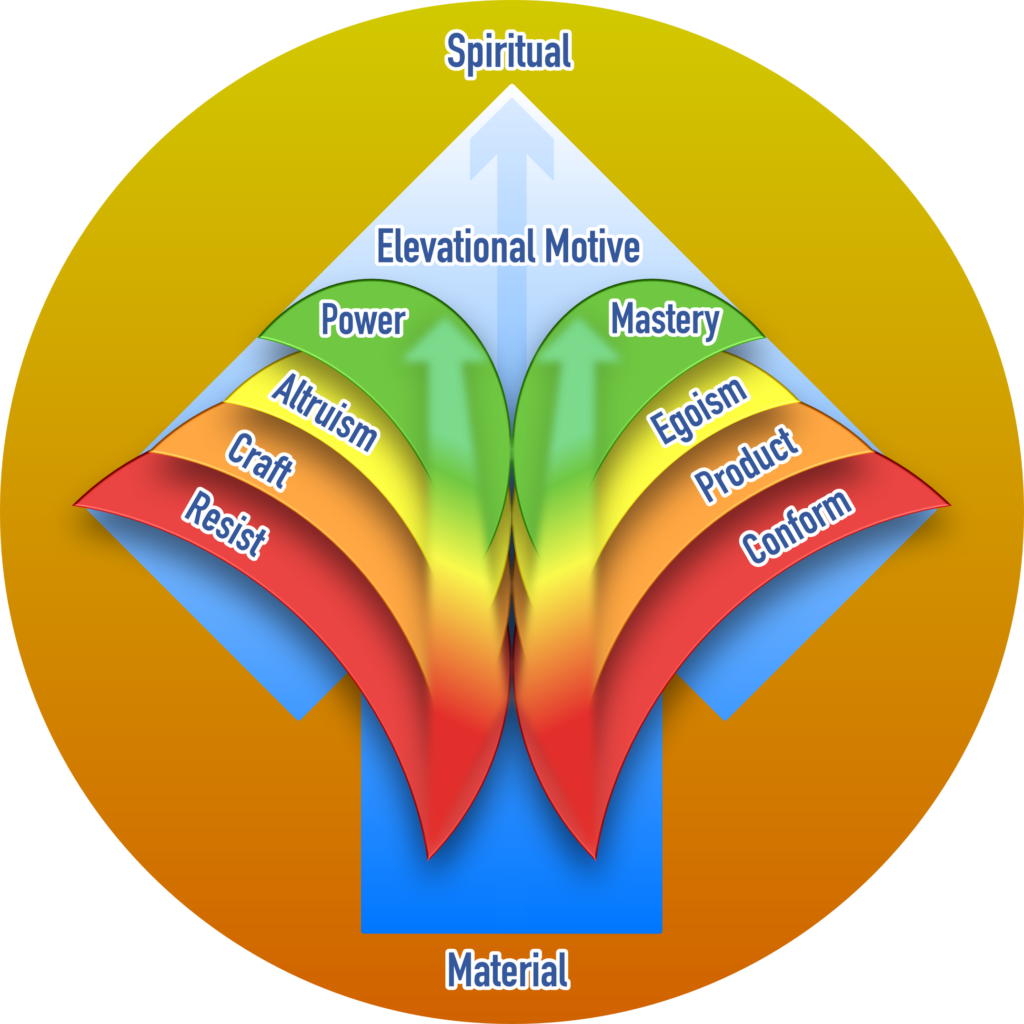
Power <-> Mastery
EROS (yellow):
Altruism <-> Egoism
TELOS (oranges):
Craft <-> Product
KRATOS (red):
Resist <-> Conform
Against the fourth domain of RS, Logos, where pursuit of truth is paramount, the sin of Envy operates fervently against the repentant dialectic, as a most insidious presentation for false desires in the material. Envy is rooted in the Lust moment of the Confusion aspect, where the soul seeks to diminish others to falsely elevate this base concept of self while clinging to all the limitations as self rather than lessons in a path of improvement (hurdle becoming the way). This Envy arises when a person refuses to acknowledge their own flaws or the worth of others, instead moving toward resentment and despair at the same time as deepening identification with their imperfections and dependencies. This sin blocks the Logos domain (especially as bolstered in the next sin of Hubris, which blocks balance in Eros domain), instancing the general denial of the importance in unseen operations through the Spirit. In Amadeus, this is epitomised by the fictional presentation of Antonio Salieri’s descent into moral and spiritual ruin as protagonist, a tragedy that unfolds from his internal corruption fuelled by Envy shading interpretations.
Sins Chart
| Aspect > / Moment V | Conceit | Confusion | Sloth |
|---|---|---|---|
| Ignorance | Amnesis | Delusion | Dependence |
| Lust | Obsession | Envy | Greed |
| Apathy | Disdain | Corruption | Procrastination |
| Fear | Hubris | Cowardice | Absolutism |
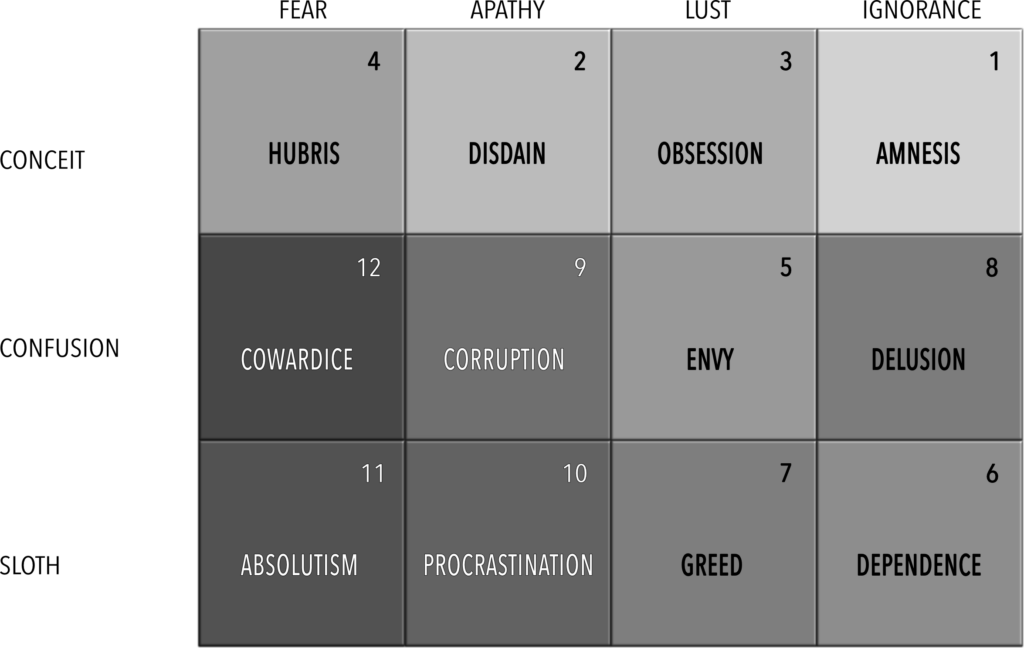
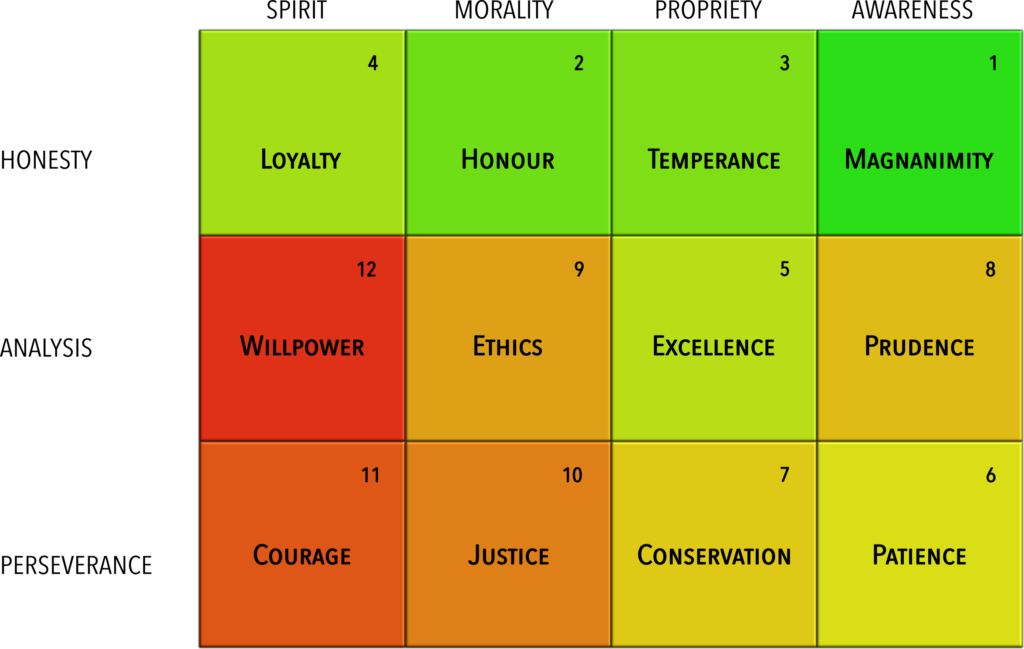
In SVT, Envy directly opposes Excellence, which resides in the Analysis aspect under the Morality moment. Excellence is the virtue that first allows us to recognise the achievements of others, thus enabling greater depths in our own. Envy, however, is its antithesis: it is the refusal to acknowledge the worth of others, leading to cycles of resentment and stagnation. This sin is powered by Obsession, which interferes with Temperance and Loyalty altogether, reinforcing itself in league with Hubris, barely masking a deeper fear of basic inadequacy. Overall there is a block in genuine Honesty to be surmounted here terminating in acquisition of true Loyalty.
Virtues Chart
| Aspect > / Moment V | Honesty | Analysis | Perseverance |
|---|---|---|---|
| Awareness | Magnanimity | Prudence | Patience |
| Propriety | Temperance | Excellence | Conservation |
| Morality | Honour | Ethics | Justice |
| Spirit | Loyalty | Willpower | Courage |
The Mechanisms of Corruption
The protagonist’s envy festers precisely because he cannot subordinate his ego to genuine loyalty (the first taste in the moment of Spirit), to the art, to truth, and ultimately to a higher purpose beyond personal glory in his own materialist plans. His “loyalty” is performative and self-serving (to the Emperor, to his reputation), never the selfless allegiance that would force collaboration or sacrifice. As a result, he never overcomes the envy; it destroys both men and leaves the protagonist in tormented mediocrity, confessing his sins while still unable to fully recognise the fictional Mozart’s excellence as pure, transcendent ability rather than a personal affront. Envy thrives when loyalty is absent or corrupted by pride. The tormented protagonist is ultimately damned by his own hubris and inability to see beyond his own false loyalty to his lower self, a man who rose to the heights but perhaps missed more in the lost directives to his next missions. He felt the talent was owed to him by God because of his dedication, not realising that God has a much bigger plan of which we cannot possibly see the full extent.
Envy, as the root sin here, is not merely a personal failing but a systemic one, reflecting the broader societal failure to value true artistry over performative brilliance. The focus upon the genius of the object of his envy becomes an obsession with his own inadequacy, a cycle of self-loathing and vengeance that mirrors the corrupting influence of Hubris against the Logos domain. His inability to recognise Excellence in others, let alone within himself leads to spiritual death in rejection of his own faith, presented explicitly when he destroys the figure of Christ on the cross, and even the act of confession toward the end becomes a performance rather than any genuine pursuit of redemption.
Envy Dismantles at Birth of Truer Loyalty
The collapse of Envy begins against Hubris in institution of Loyalty, if not a peek at its glimmer, the sin that fuels its most insidious manifestations. Hubris, rooted in the Fear moment of the Conceit aspect, is the refusal to acknowledge limitations, leading to a belief in one’s own invincibility, or rightful invincibility against all the evidence. This manifests as ego in his musical genius and belief it should be greater regardless any differences, recognised, and celebrated, even by God; that his life should be how he envisioned regardless of God’s plans in the greater scheme. This hubristic belief is compounded by Obsession, which drives him to seek validation through destruction rather than creation. His actions: planning to kill Mozart, manipulating the Emperor, and sabotaging Mozart’s work, are not acts of creativity but of domination, fuelled by a twisted desire to assert superiority.
The collapse of Hubris begins when Loyalty emerges as the virtue opposing it. Loyalty, in SVT, is the completion of Honesty strengthened by Temperance, Honour, and Magnanimity. It is the recognition that true purpose cannot be in self-aggrandisement but in service to greater good. This realisation comes too late and does not last, as his inability to cultivate Loyalty leads to a life of spiritual poverty. He glimpses the power of Loyalty, most notably in his final moments when he acknowledges Mozart’s true genius and recognises the futility in his own envy, and his judgement of the man.
The True Excellence: Vision Beyond Self
The collapse of Envy gives rise to Excellence, the first virtue acquired in the Analysis aspect after Loyalty. Excellence is the recognition that true value lies not in comparison to others but in the cultivation of one’s own potential. This realisation comes too late; he spends his life in pursuit of glory, only to be consumed by his envy and hubris. However, the film suggests that even within this tragedy, there is a glimmer of hope: the recognition that Excellence can transcend personal failure when one is willing to acknowledge their own limitations and seek growth in the humility of properly oriented honour.
Excellence, as the virtue opposed to Envy, demands not only the ability to recognise achievements of others but also the understanding in spirit, in God’s Love, to forgive ourselves our own imperfections, devotional ever-the-more to His creation in honesty. This Loyalty is the very bridge between self-awareness and collective progress, a force that allows individuals to rise above their baser instincts and contribute meaningfully to society. For the protagonist, this recognition would have required more than mere acknowledgement, it would have demanded a complete reorientation of his values, from personal glory to communal enrichment.
Dawning of Patience for Excellence and that Loving and Loyal Path Beyond Envy and Hubris
Finally, the onset of Excellence past Envy gives birth to Patience, the first virtue acquired in the Perseverance aspect after Excellence. Patience is the ability to accept delays without despair, recognising that true growth requires time and effort. This patience would have required the protagonist to abandon his obsession with Mozart’s genius and focus instead on further cultivating his own artistry or connections with other artists, and who knows what else. It would have demanded the humility to accept that greatness cannot be seized through manipulation or destruction but must be discovered through dedication and earned through integrity.
The film’s conclusion, where he is wheeled down a hallway in an asylum, underscores the tragic irony of his journey: the character was never truly able to transcend Envy. Yet, in his final moments, there is a hint that even in defeat, he begins to understand the power of Patience. The laughter of Mozart echoes through the air, a reminder that true excellence is never our own and our potential never properly measurable in the imperfect judgements of others.
In this way, Amadeus becomes a parable of the virtues and sins that shape human destiny. It teaches us that Envy, when left unchecked, leads to spiritual decay, while Loyalty, Temperance, Honour, and Magnanimity offer a path to redemption. We begin to see beyond our own inadequacies and recognise the value in others. This all requires requires time, humility, and proper alignment of values toward Truth. In a world where envy often fuels division and hubris blinds us to our own limitations, it’s our faith in God’s Love and God’s plan, that infinite fountain of hope. There is always the possibility of redemption, for those who are willing to and capable of seeing beyond themselves.
Leave a Reply