
Excellence, the Price for a Taste of Freedom in Patience
In the third domain of Resurrexit Spiritus (RS), Eros, where relationships are forged through mutual trust or exploited in trade for illusions of power; the error of Dependence is a corrosive force on both sides. To be clear, this has nothing to do with childhood, nor natural dependence of children which is good. Dependence as an error or sin must not be confused with vulnerability. Rather this is systematic failure in self-reliance, rooted in the Ignorance moment of the Sloth aspect of Materiality. Here, the soul seeks external validation at the expense of integrity, creating a cycle where reliance on others becomes a crutch made out of extraction with excuses. In Shawshank Redemption, this sin is enforced by the institutionalised prison system, which weaponises dependence to maintain control over inmates. The warden’s exploitation of Andy Dufresne, the manipulation of Red, and the eventual suicide of Brooks Hatlen all serve as stark illustrations of how Dependence can be both a trap and a foil for transformation at the outset of Excellence.
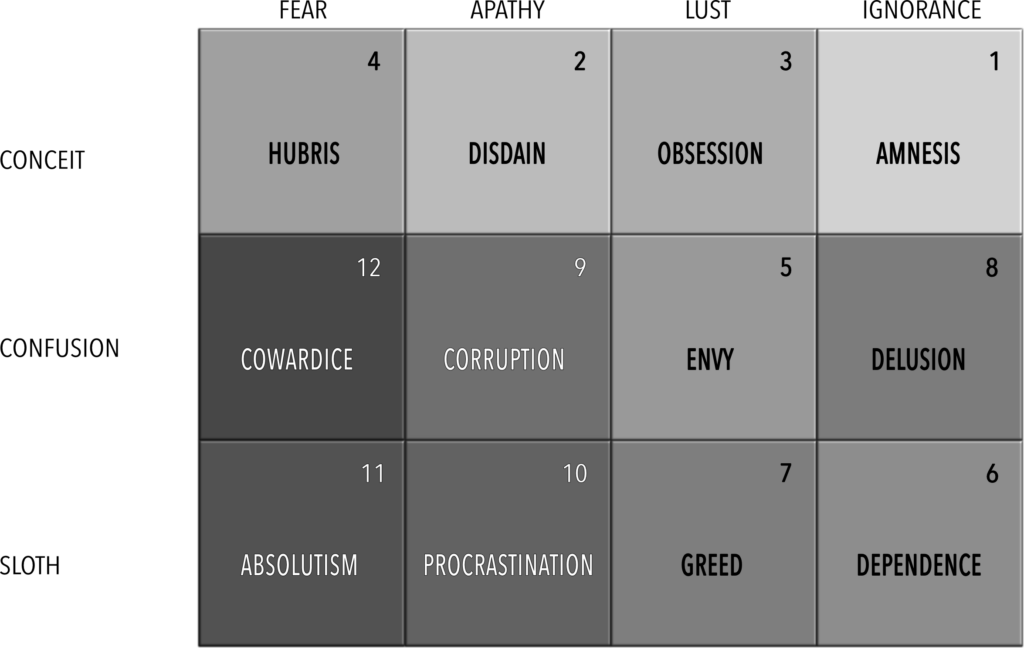
In Structural Virtues Theory (SVT), Dependence directly opposes Patience, which resides opposite sloth and ignorance in the Perseverance aspect under the Awareness moment. Patience is the virtue that allows us to accept delays without despair, recognising that growth requires time, self-reliance, and community. Dependence is a basic refusal to take responsibility for one’s own development, leading to a state of spiritual and emotional stagnation. This sin is deeply entwined with Envy, Hubris, Obsession, Disdain, and Amnesis, each feeding into the other in intra-perpetuating cycles of disorder and mutable reactionism.
Andy landed himself in prison through a course of all the sins in SVT: starting with the lack of Magnanimity necessary to overcome his out of balance sense of Honour. He felt the draw of Disdain and Amnesis, in ignoring or forgetting whatever parts he played in the collapse of his relationship (it’s unclear with lack of detail given in the film), and even the act of murdering his adulterous wife and the adulterer with her. Obsession and Hubris were in full swing opposed to Temperance and Loyalty, he felt was fully corrupted. Perhaps he felt there was more Honesty in his relationship than was actually present. We’re left to wonder if all of that which led up to murder was actually finally enacted, though all evidence points yes, and Andy consistently says no, sometimes mocking his own futility in the refrain as he did.
The prison systematically operates under the delusion that power can best be maintained by ensuring prisoner dependence. The prison allowed prisoners to be abused by others, as Andy experienced. This essential Hubris built into the core of the institution leads to over-confidence in authority, while Envy of Andy Dufresne’s quiet resilience by the warden fuels a desire to destroy him. The guards, too, are consumed by their own Obsession with maintaining order through fear, fuelling their Disdain. Prisoners are broken down, and generally driven into deepening sin and error rather than lifted by strengths.
The tomb of errors is sealed by the great stone of Amnesis, the refusal to remember or confront the truths of their sinful existence, and why they are present in the prison. The prison designs a new identity for the prisoners. This is evident in the way inmates accept their prison lives as permanent realities, unable to envision a world beyond the walls. For Andy, the cold silence becomes ally and depths of thought with books as companion, the only respite.
Sins Chart
| Aspect > / Moment V | Conceit | Confusion | Sloth |
|---|---|---|---|
| Ignorance | Amnesis | Delusion | Dependence |
| Lust | Obsession | Envy | Greed |
| Apathy | Disdain | Corruption | Procrastination |
| Fear | Hubris | Cowardice | Absolutism |
Machinery of Control
The prison functions as a microcosm of society’s dependence, where survival is contingent on moneyed whims. Andy Dufresne, the protagonist, is physical confined here but also by the forced (in more ways than one) dependence he must endure to survive. His first spark of defiance is met with brutality and humiliation.
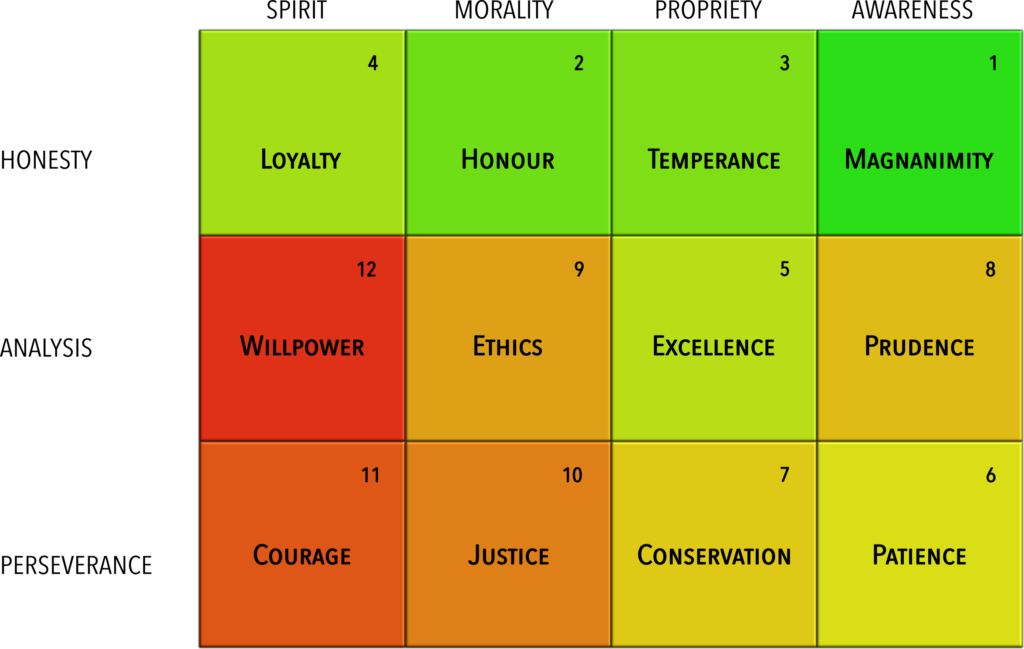
Andy’s journey begins with his recognition that survival there requires more than what is immediately visible; it demands Excellence, a virtue that enables him to transcend the limitations imposed by the prison system. He first displays this in taking advantage of the head guard’s greed and hubris while working, to benefit his peer prisoners. He was able to “curry favour” with both guards and other inmates. This Loyalty and Excellence is necessary to arrive at Patience, past its opposite in Dependence. Years of quiet observation and calculated action allow him to build the tunnel that ultimately frees him. This is all very symbolic. This is the result of deliberate cultivation in Honesty, Loyalty, Temperance, Honour, and Magnanimity, all of which integral to the virtue of Excellence.
Virtues Chart
| Aspect > / Moment V | Honesty | Analysis | Perseverance |
|---|---|---|---|
| Awareness | Magnanimity | Temperance | Patience |
| Propriety | Temperance | Excellence | Conservation |
| Morality | Honour | Ethics | Justice |
| Spirit | Loyalty | Willpower | Courage |
Collapsing Dragon (Dependence) | Birthing Tiger (Patience)
The collapse of Dependence is gradual, beginning in quiet resistance to oppressive systems internally, to refuse their abuse. His Excellence is the ability to see beyond the immediate constraints of his environment which allows him to plan and implement his escape. This quiet defiance residing in Excellence overcame much of the very real Dependence foisted upon him, with the Patience required to endure years of institutional manipulations. Andy makes himself so valuable to the prison and guards with his Excellence that he turns the entire table of Dependence over, forcing their Dependence upon him. His hard work to gain more funding for the library pays off, gifting him motivation.
The film’s central metaphor, the tunnel like his hard work for the guards and prison, is Excellence itself, symbolising the slow, deliberate work of overcoming Dependence (prison) and achieving true Patience (freedom), making others dependent instead. Emergent evidence of Andy’s innocence was at first simply disregarded by the warden, who afterwards had the young man whom was witness shot; a young man whom Andy had helped improve himself. Given another month of solitary after learning this, he recognises his own part in what tore his relationship apart. Innocent Andy, forced into this situation, had no other way out. He had no other option but the tunnel, Excellence. Andy’s use of a rock hammer to chip away at stone over decades presents the reified Perseverance and Patience necessary to break free. His recognition of his part in the death of his wife signifies a massive leap in virtues, past Greed or Delusion, launching into full-scale Conservation, Prudence, Ethics, and Justice. Finally, he mounted the Courage to do it, to escape. His gifts had been manifest to all, especially when playing the music for the whole prison at great cost to himself. All his actions were caring, methodical, and calculated with the precision of someone who had developed reserves in Loyalty, Temperance, and Honour. This is the essence of Excellence: the ability for integrity of action even when faced with overwhelming odds, and even against envy and murderous manipulation by powerful people.
“Some birds aren’t meant to be caged, their feathers are just too bright, and when they fly away the part of you that knows it was a sin to lock them up does rejoice…”
The other prisoners, particularly Red and Brooks, serve as parallels to Andy’s journey. Brooks’s decision to end his life stands prominent in both Andy’s and Red’s minds. Andy does not want to die in prison. Initially trapped in absolute Dependence, most are unable to even envision a life beyond the prison. It is only through Andy’s Excellence, his quiet defiance and unwavering commitment to his goals, that Red begins to see the possibility of freedom, first within then without, in mirror (jumping parole which isn’t smart, signifying the retention of Delusion and Greed, but…). Andy talked a lot about what is inside that they cannot take away, most especially hope, as did Red on his trek to meet his friend. The most poignant moment in the film occurs when Red follows Andy’s trail of breadcrumbs (the rock under the oak, the letter, the bus to Mexico, and following directions with care), symbolising a rejection of Dependence in favour of self-reliance and Patience, leading potentially to Conservation, Prudence, and beyond.
Recognition of Excellence is more than just some exercise of intellect; it is the initiation into Analysis and the awakening that allows individuals to transcend originating limitations. This is most evident in Andy’s ability to inspire others through his actions, even as he remained largely silent. His Loyalty to his fellow inmates, demonstrated by his efforts to improve the prison library, expanding access to culture/education, helping with legal cases, and assisting in their improvement, is testament to the sheer power in empowering others; the only real power.
Hints of Sweet Freedom
Dependence so suffocates the germ of virtue, that even the idea of freedom becomes unbearable, as proved by Brooks. The film’s conclusion on a beach far away is symbolic of triumph over Dependence, and the arrival of Patience. Patience, as the first virtue acquired in the Perseverance aspect after Excellence, is what enables us to see beyond the illusions cast upon us, especially in that which weakens. Never resignation, patience is active engagement with the process of growth, as recognised in Excellence. However Patience is not the complete freedom, but a mere taste of it, which is fully identified through Ethics and Willpower (at Analysis into Morality and Spirit) to be in the ability to recognise and accomplish Good. This was achieved most through his empowerment of other prisoners, his greatest accomplishments in Good. The problem, ultimately, is in Greed and Delusion not knowing when enough is enough while in reality we are to act as a funnel for further progress.
Leave a Reply