
The Tyranny of Certainty: How Absolutism Distorts the Soul’s Path to Justice
The 1950 film Rashomon, directed by Akira Kurosawa, is a masterful exploration of the human soul’s deepest contradictions. I’ve been a big fan of Kurosawa since discovering his work as a teenager, however this is one which took time and experience to fully appreciate. At the heart of this film rests a profound meditation on Absolutism, the sin of mortals pretending infallibility, without room for nuance based in their own actual very real sinful fallibility. In Structural Virtues Theory (SVT), this sin arises from the Sloth moment of Fear, where no other excuses remain, and the mind clings rigidly to false beliefs as though they were divine mandates. Absolutism is the antithesis of and blocks the onset of Courage, which embodies balanced judgement and the recognition that the only thing more absolute than human fallibility is Truth. So our source of woes is never in truth itself, but in our failure to embrace its complexity due to our mortal sinfulness and tendency toward errors.
In Rashomon, this sin manifests through the conflicting testimonies of four characters: a woodcutter, the samurai (medium), the wife, and the bandit rapist-murderer, Tajōmaru. Each gives a version of the same murder (or suicide), with accounts shaped by personal bias, fear, and self-interest. The film’s brilliance shines through in its early refusal to offer a single “truth,” instead exposing how Absolutism distorts reality when individuals cling to certainty of their own interpretations without regard for nuance or context.
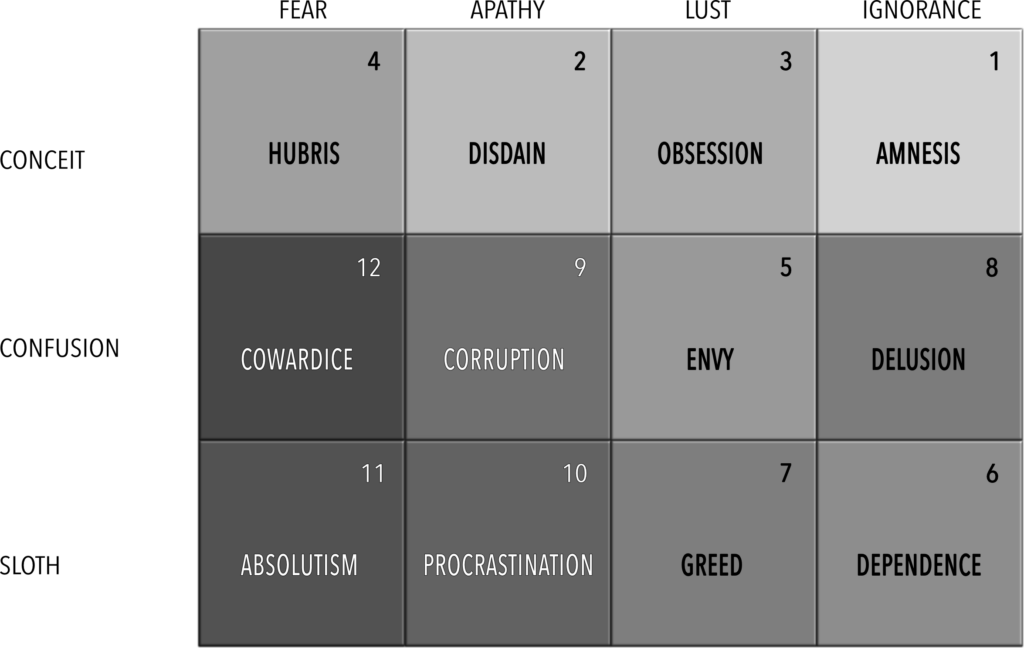
The thief, being told about the variations in testimonies by the woodcutter and monk, says “Most of the time we can’t even be honest with ourselves.” “It’s because men are weak that they lie, even to themselves,” responded the monk. This mirrors SVT’s assertion that Absolutism operates against the Logos domain atop Telos, where the balance between product (the outcome) and craft (the process) must be reformed. A person steeped in Absolutism sees only their own ends, ignoring the intricacies of reality, and in doing so, denies the viability of any just logic beyond their narrow mortal perspective and particular interests. This is why humans lie most, because they put their desires first and hate being judged as less, most especially by their own measure.
The Death of Justice: How Absolutism Destroys the Moral Order
In SVT, Absolutism is challenged most by the Justice virtue, which requires ethical discernment through its three completed Morality moments. The absolutist’s refusal to consider nuance or context ensures a world where moral relativism reigns, and all individuals become tyrants in their own minds. Absolutism begins where we are stopped by Fear. Our Fear derives from uncertainty. This means being wrong, losing control, and enduring things outside Materialist desires. This is the epitome of a “useful” laziness, as all questions melt away and trouble the person no longer. In Rashomon, this lazy reaction to uncertainty manifests as each character’s insistence on their lie, each refusing to acknowledge the truth for their own reasons and in their own ways, though primarily because their false senses of Honour demand they not dig any deeper for the truth. Most of these reasons have to do with false senses of Honour, each lying to cover their shame. If the samurai had killed himself after the assailant had left, then why would the assailant claim the murder at all? The wife obsessed upon the dagger and used it in her invention because it was the beautiful object of her shame, so the diviner (“husband”) was focused upon it as well. Some viewers might be tempted to believe the diviner’s story, but then this denies the very real place of the warped Honour held by the samurai in the story and the assailant, Tajōmaru, would have had no motive to lie in order to implicate himself more than what was necessary. The medium’s testimony is the least reliable as the most theatric and convoluted. If the medium were sharing the actual testimony of the samurai, the lie about him killing himself might have theoretically served his distorted sense of Honour in preference to having died in such desperate and dishonourable combat after so grievous a display of cowardice, but it is all too absurd to accept. The lies of Tajōmaru regarding the murder revolve around making himself appear more honourable and skilled in the combat.
A guilty person typically lies in a confession to a crime for the purpose of covering over what they view as something worse, minimising the deed in their perspective of the judgements from others. If the suicide were true then Tajōmaru could have just as easily stated the fact that he left before the samurai was dead, which was his lustful intention in “taking” the wife without having to “kill the man.” The wife claimed the assailant did exactly as he claimed he wanted to do rather than murder the man by his own testimony, which is all very strange.
The lies of each are all founded upon Absolutisms they tend to within which they demand override truth, to maintain their false identities, recreating reality to suit as they go. The assailant is delusional and bragging but would have bragged more had certain parts of the story of the wife and husband been true, such as the suggestion that he had succeeded in “taking her without killing the man” or that she had accepted a marriage proposal by the assailant. The lies of the assailant were all surrounding protecting his own false sense of Honour, which turned around prowess, variously, as he saw it Materialistically: in combat and “romance.” This is supported by his obsession with a woman being “ferocious,” or when he stated “no man has crossed swords with me more than 20 times.” He could not acknowledge his crimes as anything more than daring do and bravado amidst chaos, romanticising every deplorable thing he did, submerging all actions in fantasy. Everything he did was honourable from the perspective of his strength and fierceness, while he served his every lust and desire without hindrance.
The wife was ashamed she could not stop it, obsessing about the dagger in her strange confession, being driven to madness after being made to feel like refuse by her cowardly husband using her dishonour as a scapegoat for his Apathy. She could not acknowledge any interactions with the assailant before or beyond the rape and therefore had him leave immediately in her version of events. She had her husband silent throughout, saying nothing, because she hated what he said. She would rather be thought a murderess who couldn’t remember than what the woodcutter revealed about her madness at her husband’s dishonourable cowardice using her exploitation to excuse himself from responsibility, attempting to protect her Honour and his which hers was based in. She needed it to be a tragedy where her madness did not make her seem more culpable.
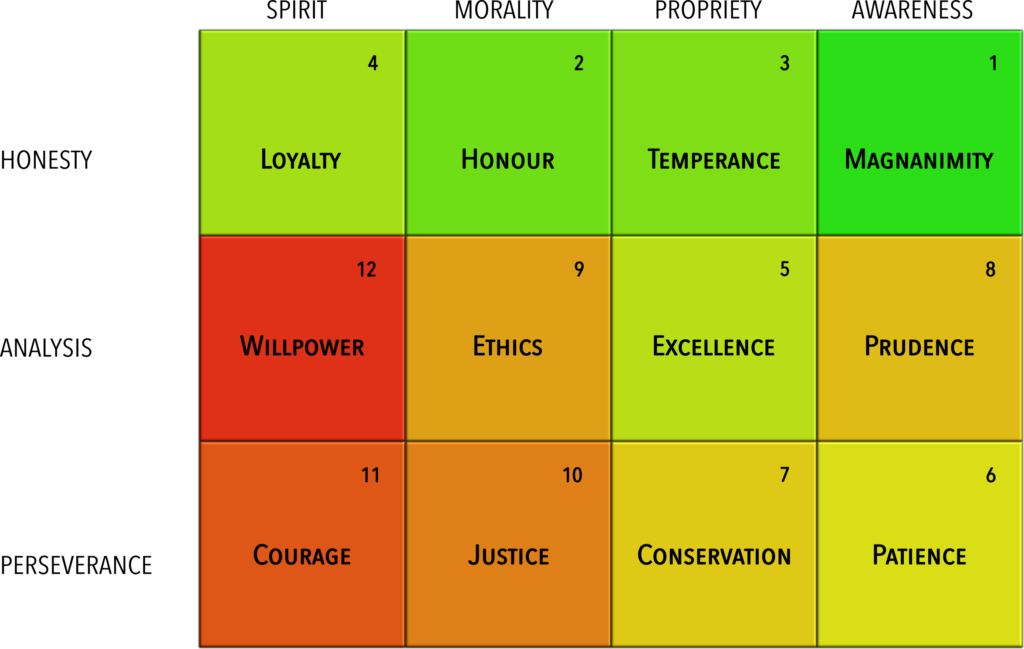
The film’s central tragedy is its representation of a society where Absolutism breeds division and impedes Justice while forcing people to excuse their sins with lies they use to fool themselves most, ultimately obliterating all perception of truth. When individuals cling to rigid ideologies which do not conform to reality nor account for the unseen potential in trust, they disallow reasonable moderation. We create factions around our versions of events that resist compromise, turning us into enemies in conflict yet sharing in nothing but stagnation. People insist on their own version of truth, refusing to entertain the possibility that their accounts may be incomplete or even false. The result is a world where Justice appears impossible and the very act of seeking truth becomes a false exercise in self-aggrandisement rather than humility, at worst, and mockery at best. The thief, who judged the woodcutter, was projecting and revealed more about himself than the woodcutter in it.
The woodcutter was in shock at the depravity shown by all parties involved in the events, most of all perhaps in his own Cowardice. The real events which transpired were apparently desperate and devoid of any Honour on the part of anyone. The wife having been traumatised and then rejected by the man that should have been her hero succumbed to madness. The truth was more awful than any were willing to admit, with plenty of shame to go around. The samurai was a coward who only fought the assailant when forced to do so, after his ploy of blaming the dishonour of his wife did not work to alleviate risk.
The Virtue of Justice: Restoring Balance Through Ethical Discernment
To conquer Absolutism, one must confront the illusion of certainty. This involves interrogating the assumptions that underpin rigid thinking: Are these beliefs based on truth or fear? Are they rooted in a desire to control or a need to avoid discomfort? Justice, as the virtue which conquers Absolutism, demands our humility. We are but mere mortals capable of discernment only insofar as we have attached ourselves with the depths of goodness in God, as His children, and no further by design. In Rashomon, this process in humility is symbolised by the woodcutter’s admission that his official testimony was falsified, that even he was lying to himself (though perhaps to feed his many children). It is true that he left the dagger out of his report entirely, but that was not the primary lie, which was in the omission on his part.
This humility as Magnanimous element backing moderated Honour is essential for development of Ethical discernment, the foundations of Justice. These Ethics and Justice virtues comprise the ultimate measure in human morality but are easily corrupted by misaligned Honour, where we find Disdain regressively supplanting it. In Rashomon, the monk’s and woodcutter’s final acts of compassion, rescuing and adopting the infant, symbolise the necessary eventual shift from Absolutism back to Justice. By embracing the fragile human truth and the need for shared responsibility, the monk and woodcutter both act and thus restore a semblance of moral order to the world believed was irredeemable and beyond understanding. SVT asserts Justice aligns Perseverance with Moral clarity in preparation for Courage, ensuring that our actions are guided not by some unthinking rigid certainty but by deeper wisdoms guided by humility as open to corrective collaboration.
Absolutism in Community: Conquering Absolutism Through Justice
The real story is never found in any single testimony, but in the collective efforts to seek after greater Justice, and the good. The monk and woodcutter taking the abandoned child into their arms symbolise the triumph of community’s discourse over individual Absolutism and confused senses of Honour. This moment underscores Absolutism being conquered by Justice is a social setting, requiring the cultivation of Prudence and Ethics, against Delusion and Corruption, of those who would participate.
The abandoned baby, left alone at the Rashōmon gate is a powerful metaphor for truth in a world rife with contradictions. Just as the crying infant is vulnerable to the harsh realities of Materiality, so too are we all susceptible to the allure in the false security of Absolutism as a lazy tool against the chaos. Yet, as Kurosawa’s film shows, it is through Honesty virtues in community with a moderated Honour that we can transcend our individual limitations, assure the best outcome, and embrace the truest form of Justice: one that acknowledges the complexity of human experience without succumbing to fallible dogma or ruthless self-interests.
The Final Virtue: Willpower as the Key to Transcending Amnesis
In SVT, the final virtue of Willpower is the extension of originally borrowed force that enables others to move beyond their own limitations. In Rashomon, this is exemplified by the woodcutter’s decision to raise the abandoned child along with his own, an act of Willpower that transcends his earlier Cowardice, inspired to be the one to do right by the false Honour of the wife and samurai in proclaiming lies instead of admitting their own weaknesses and errors. Few will believe even when you do finally admit to the truth. Truth is found in the willingness to confront uncertainty head-on and without excuse making, especially if it threatens our sense of control or we risk being judged. Obviously the woodcutter was the one with the least of motives to invent, and was the one most transformed by the sadness of the entire situation. He was defensive regarding the possibility of the dagger being the murder weapon because he was sure it was not, having witnessed it all. The other three accounts are filled with theatrics, and come across as based in their own false ideas of themselves. They all lied to hide their shame and protect their false identities. The woodcutter admitting to lying about having stumbled upon the scene rather than being a witness, this was Cowardice, and yes he probably took and sold the dagger, but it was clean and was not used in the murder, so that contradicting the testimony of the others at the same time as being caught for having sold the dagger might have potentially implicated him, or even encouraged a relative of the victims to kill him. He found the dagger in the road, where both the samurai and wife claim to have found it in their fraudulent versions of events.
Rashomon is a film with a thoroughly Christian message. It stands as a reminder of the power of Truth, Courage, and Justice to restore balance in a world where false certainty and ideas of Honour often blind us to realities just beyond our grasps, yet we choose to remain in this blindness. The Buddhist monk’s restoration of faith in the human soul after witnessing the adoption further underscores the importance of Willpower as a divine gift. By choosing to act with compassion rather than despair, the woodcutter demonstrates that even the most deeply entrenched of Absolutism can be overcome by simply moving Justice forward, which is to say searching out the greatest Good available to us, something rare in the story. This aligns perfectly with SVT in Willpower being the final step in overcoming remnants of Amnesis in self and then seeking it out in others, ensuring that the lessons of the past are not forgotten but carried forward as foundations for future growth, in God’s will, and the power He borrowed to us from the beginning.