
The Weight of Inaction: Cowardice as the Most Foundational Sin and the Last to be Conquered in Materiality
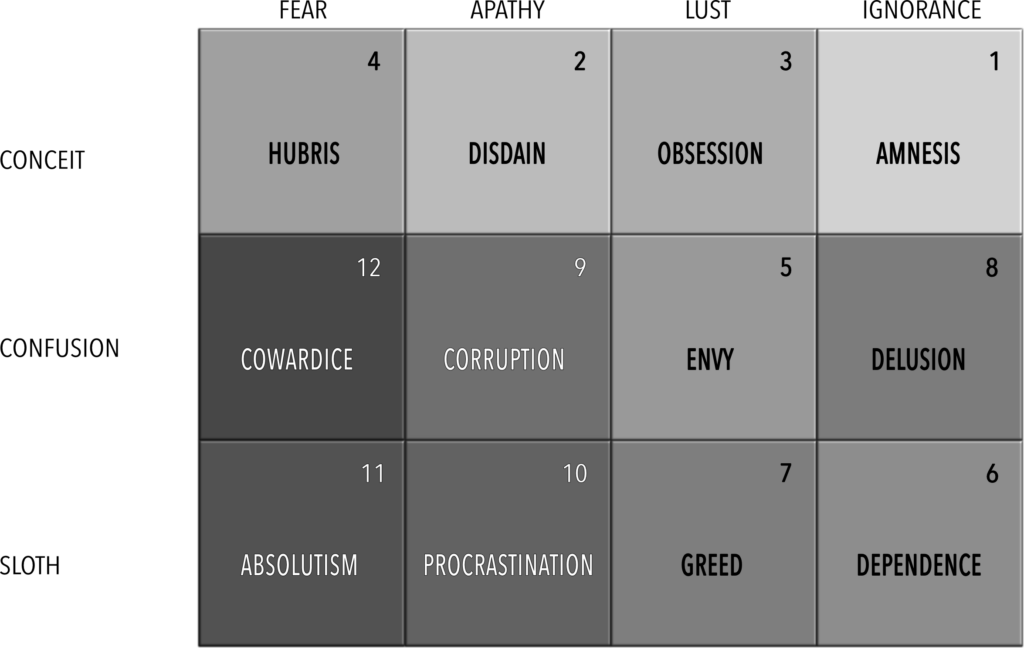
Hamlet, whatever version you wish to watch, is a clear mirror held to the human soul’s deepest struggles, revealing how the sin of Cowardice, rooted in the Fear moment of the Confusion aspect, paralyses action and distorts the path toward truth. In Structural Virtues Theory (SVT), Cowardice is the most foundational and last to be conquered; a refusal to engage with the unknown, a self-imposed exile into the realm of evasion. Throughout most of life, we contend with the seen, ignoring the unseen with many now even doubting anything could be extracted from the unseen, so that we indeed have something akin to ubiquitous Cowardice infecting the West on a societal level. Cowardice manifests with retreat from confrontation, cloaked in illusions of potential external salvation. a profound exploration of the structural virtues and their interplay within the human soul. In SVT’s framework, these sins and virtues are abstract yet firmly rooted to concrete realities with definable boundaries that shape all lives and all communities across all cultures. Through the intricate narrative of Hamlet’s story, Shakespeare illustrates how Cowardice can be overcome through Courage, how Procrastination fuels Absolutism, and how community must be rebuilt through shared virtues which revolve around the Willpower of the older generations to assist the younger in overcoming the Amnesis which blocks even the realisation of the other sins.
Prince Hamlet’s ignored obligations are imposed upon him by society and family. He cannot bring himself to act because of all the implicit contradictions in the situation. Shakespeare’s famous soliloquy put into the mouth of the protagonist perfectly illustrates Hamlet’s issue: “Thus conscience does make cowards of us all.” Here, Shakespeare unveils the soul’s deepest conflict and the origin of all morality: the tension between reason and action. Hamlet overthinks. His fixation on potentialities is an intellectual failure to reconcile thought with deed. This is Cowardice at its core: a rejection of responsibility, a position guided, somehow, by a belief that some element in truth is too dangerous to deal with.
SVT posits that Cowardice works against the Logos domain operations in the Kratos domain, where rejections and acceptances of rules of identity itself are reshaped. In Hamlet, this manifests in the prince’s refusal to embrace his duty as avenger, even as the ghost of his father demands it. His inability to act is a lack of Courage based in an ignorance of its necessity, a curtailing of the very principles which demand it. This ignorance creates a gnarly feedback loop: the more Hamlet avoids action, the more he reinforces his entrenchment in Materiality, where truth becomes irrelevant and purpose evaporates in the mists of overwrought thoughts framing inaction.
The Danish court is a setting chosen very carefully by Shakespeare as a symbol of Cowardice’s dominion sharing borders with Corruption, Hubris, Absolutism, Disdain, and Procrastination: a place where corruption thrives because the soul has abandoned its duty to act. Hamlet’s indecision allows Claudius’s tyranny to persist, illustrating how Cowardice enables injustice and erodes the fabric of virtues most inwardly.
Courage: The Antidote to Cowardice and the Penultimate Step on the Path to Truth
In SVT, Courage is the virtue that directly contradicts Cowardice. It resides in the Perseverance aspect under the Spirit moment, demanding unflinching engagement with truth even when it threatens comfort or safety. The Spirit moment is completed here in its crossing from the Perseverance aspect back into Analysis, hot off Ethics, but now in the frame of ultimate Loyalty: God’s Love and our truer love based in it. In Hamlet, this Courage is not found in Hamlet himself at first but in his friend Horatio, who remains steadfast in his loyalty and truth-telling. Horatio’s role as a witness to the ghost and to Hamlet’s madness is pivotal. Courage requires allies and such deep affections in Loyalty, for even the most righteous souls need others to hold them accountable.
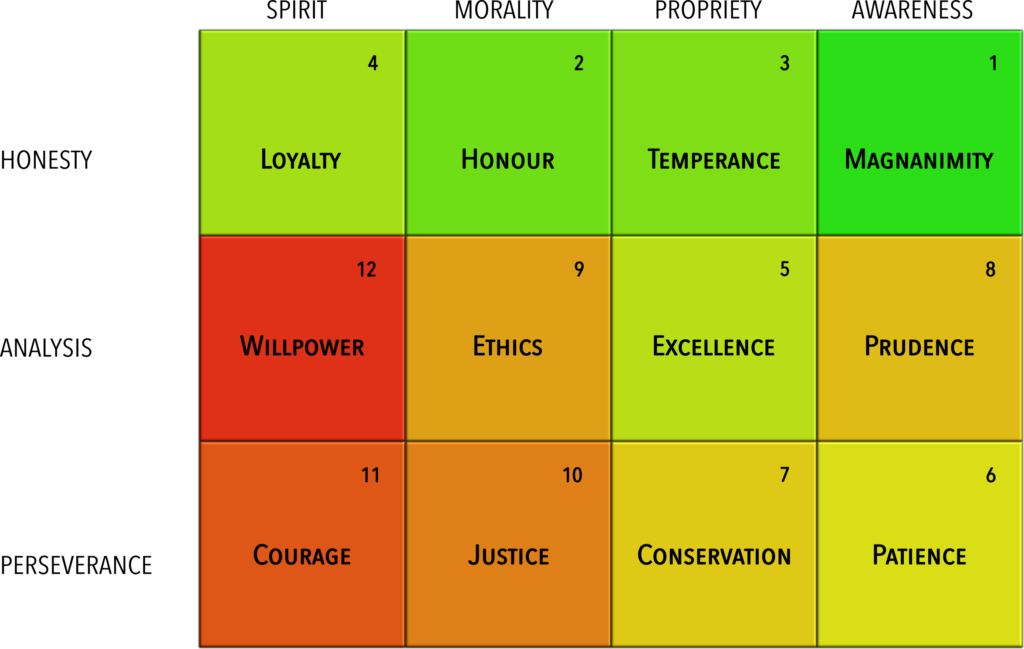
Shakespeare, much as SVT, presents Courage as a complete triumph over Cowardice; as an iterative process, demanding repeated acts of will, in order to deconstruct insidious lies and contradictions. Hamlet’s eventual decision to kill Claudius is not sudden but the result of countless moments where he confronts his own fear, even as he wavers. This fits SVT’s premise that Courage is no single act but disciplined constancy, forged through the repetition of small, deliberate choices to face truth rather than retreat into self-deception. After one truth is revealed, comes those proceeding forth from it.
Every scene of the story is a step in the journey from Cowardice to Courage, and finally Willpower. The stage itself becomes a metaphor for the soul’s struggle, each act of hesitation or resolve shaping the narrative as it unfolds. In this way, Hamlet is more than just a regular tragedy but a treatise of philosophical allegory, illustrating how Cowardice can be overcome through the cultivation of Courage, even in the face of overwhelming fear, revealing even the purpose of the final virtue in Willpower’s importance in overcoming Amnesis in others.
The Interplay of Sins: How Cowardice Fuels Other Vices and Amnesis, the Final Error, Forgets Them
Cowardice does not exist in isolation, though it is the most foundational sin which enables others to expand, most especially through the ever-regressive capstone trashing sin of Amnesis, blocking the first virtue of Magnanimity. In Hamlet, the interplay of sins is evident in how the protagonist’s Cowardice-based indecision forms around and shifts into Absolutism, where his views on the morality of the majority (e.g., viewing the world as “an unweeded garden”) blinds him to nuance and compassion. His absolutist worldview, rooted in fear of consequences and the Sloth aspect of Materialism, creates a fictional moral dichotomy that stifles the truer ethical discernment enabled by greater moderation, and the expansions in potential options.
This ties directly into SVT’s framework: Absolutism, as opposite Courage, is the direct negation of Justice; Courage which requires the completed Morality moments for the full expression of moderated Honour and Ethics. Hamlet’s refusal to act because he fears the moral cost of vengeance leads him to a paradoxical state in that his own inaction becomes a form of injustice, as Claudius’s corruption continues unabated. As Marcus Aurelius penned, “you may commit injustice by doing nothing!” The symbolism of the wasteful court reinforces this: the opulent decadence reflecting Cowardice allowing Corruption to thrive through Absolutism and Procrastination, as Hamlet’s hesitation becomes a catalyst for further decay in his own moral standing, forcing him into worsening situations.
Moreover, Cowardice and Absolutism cradle Procrastination, like some chair pretending to a thronedom of intellect, paralysing action through the illusions of infinite time. Hamlet’s repeated delays (staging the play, bizarrely sparing Claudius during prayer for absurd reasons, et al.) represent psychological traps born from doubt and fear out of too much digression amid danger. These personal failures in delay are systemic, as they allow Claudius to consolidate all his power as Hamlet remains mired in constant self-sabotage, rather than seeking out the greatest good he could accomplish.
Hamlet’s internal monologues in despair reveal Procrastination thriving on some illusion of control, and capability above actual station. He is bolstered in this by his actual station as prince, adding all the more to the weight in his detriments. By avoiding action in mounting fears of greater loss (normally a righteous fear), Hamlet ineffectively avoids the discomfort of responsibility through deepening entrenchment in Materiality’s Fear and Confusion, where truth and purpose become irrelevant.
The Role of Community: Conquering Cowardice Through Collective Work
In SVT, the project of moving from Cowardice to Courage is never an individual endeavour but communal as won in service, requiring the cultivation of the virtues. Hamlet illustrates this through its depiction of the Danish court, a microcosm of society where Disdain feeds collective inaction’s Apathy enabling Procrastination and Corruption, which thereby double down on the Cowardice. When Hamlet refuses to act, others are emboldened to follow suit, creating a culture of complacency.
When Hamlet finally confronts Claudius, kills him, and then dies, he cleanses the court of corruption through his relation and declared heir, Fortinbras, as a symbol of new beginnings and hope (one is of course left wondering if there could have been a better resolution). This mirrors the SVT assertion that community must be built (rebuilt) through shared virtues, as the individual’s Courage to act becomes catalyst for collective transformations. Hamlet passes on the torch, having achieved a belated, if rather extreme, Willpower.
The role of Willpower in this process is paramount. In Hamlet, Willpower is not an inherent trait but the extension of a borrowed force, often pushed upon the sinner by circumstance or the influence of others. Hamlet’s final moments are a testament to the force in a godly Willpower aligned to the Good, as a means to transcend pain through disciplined action, rather than simply shield against it. This passing of the torch reflects the necessity of the final virtue in Willpower serving to enable others in the Magnanimity against Amnesis of those yet poor in the Spirit, a righteous borrowing. Willpower in the strong completely destroys the final sin of Amnesis blocking the first virtue for others, in remembrance of lessons and the patterns to arrive at them most.
The Virtue of Magnanimity: The Lasting Triumph Over Amnesis in Community
The resolution underscores the importance of Magnanimity, the first virtue in SVT, which requires remembering one’s identity and purpose even in the face of adversity or failure. Hamlet’s final acts of naming Fortinbras his successor and entrusting Horatio with his story, is a gesture of Magnanimity handed down and enabling the others, acknowledging that the truest legacy is the glory in continuity of Truth.
Amnesis, the twelfth sin in Materiality, is conquered through Willpower. In Hamlet, the prince’s final moments reveal how Cowardice can be overcome by the Courage which ultimately derives from remembering one’s purpose and identity as children of God, even as death looms. Hamlet chooses to act with integrity, ensuring his story will not be forgotten. This mirrors the story’s thematic emphasis on Truth as the highest value, a principle that transcends individual failure and collective corruption, as in all things and across all domains in human understandings.
The role of community in this triumph is undeniable. Horatio’s promise to tell Hamlet’s story becomes a metaphor for how Magnanimity requires others to carry the torch of Truth, even if just the one, ensuring that these lessons we carry are not lost to history. In this way, Hamlet urges audiences to confront their own Cowardice and embrace the virtues that lead to the truer freedom in the ability to recognise and accomplish lasting Good.