
Greed, Dependence, and the Quest for Meaning in a World of Illusions
In the first domain of Resurrexit Spiritus (RS), Kratos, societies and individuals define themselves through the acceptance or rejection of rules. In Rain Man (1988), this is figured in Charlie Babbitt and his practice of manipulating systems, a system of rules exploiting rules of a larger system, justified by obsession with material gain and ethical poverty. His rise to wealth is built on exploitation of others, using their vulnerabilities as tools for personal enrichment. The rules he creates are not for justice but for control: he overrides ownership, fabricates narratives, and takes advantage of dependencies to maintain a Delusional sense of self-worth.
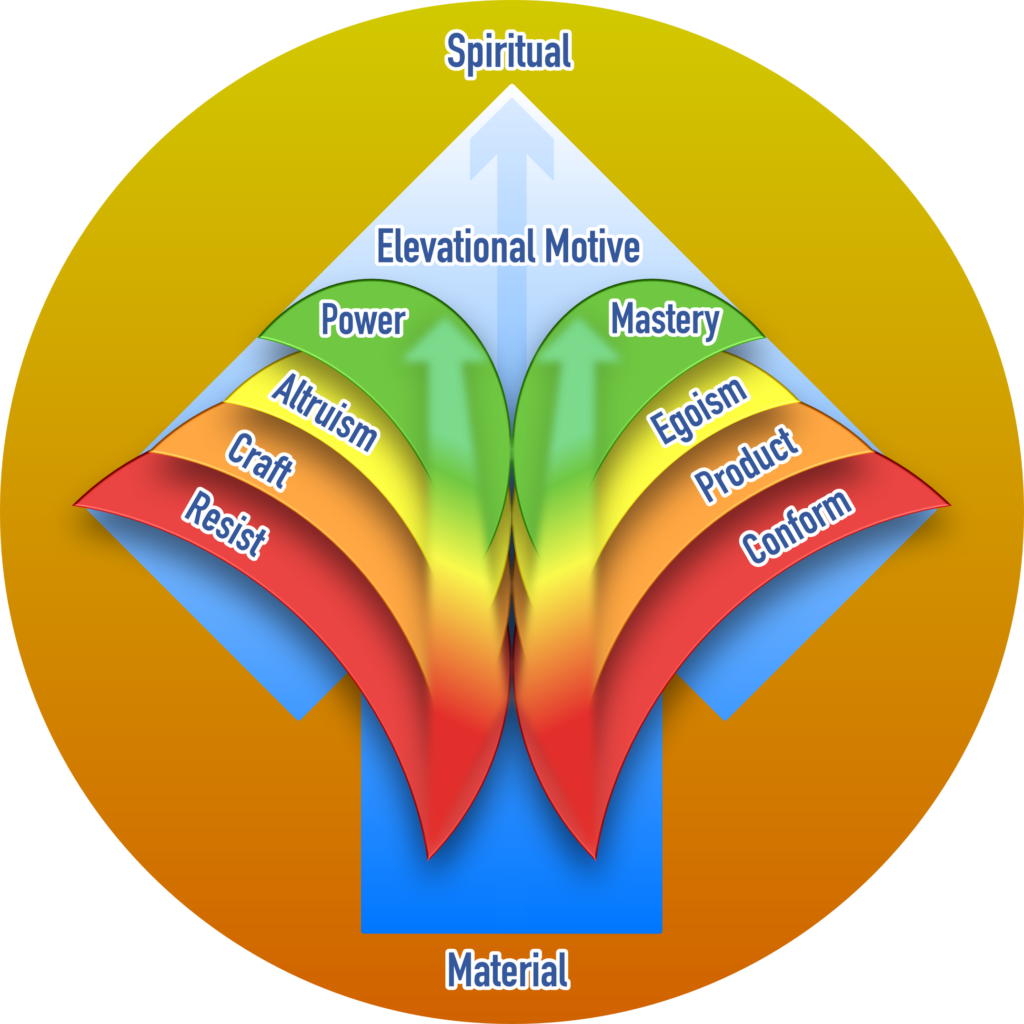
Power <-> Mastery
EROS (yellow):
Altruism <-> Egoism
TELOS (oranges):
Craft <-> Product
KRATOS (red):
Resist <-> Conform
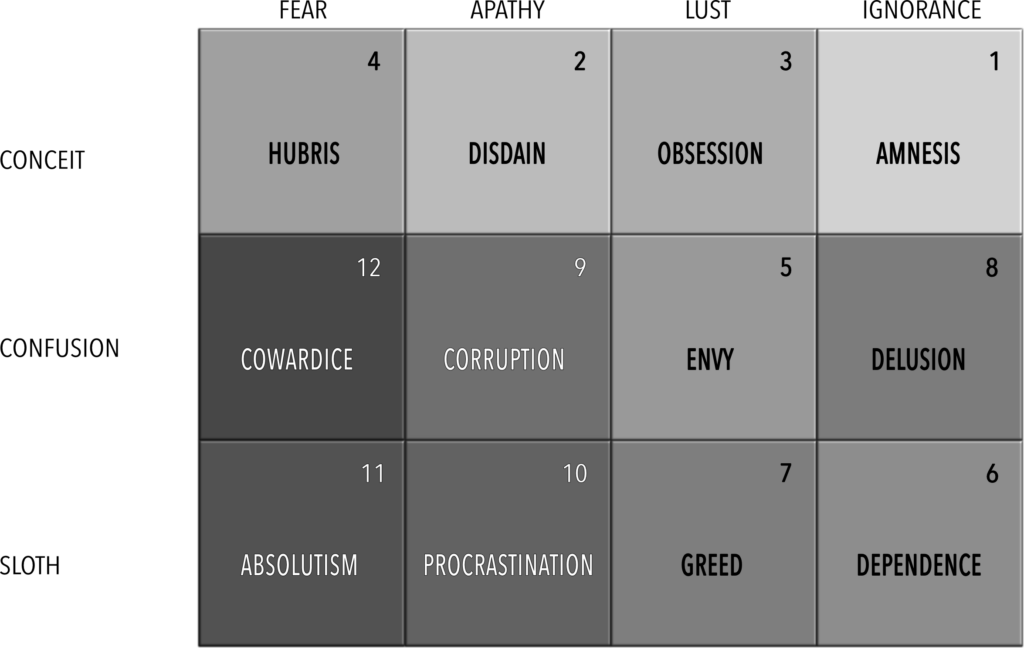
Greed operates against the domain of Telos, where goals and purposes in craft and product are entrapped by extremism in the pursuit of wealth at all costs. His obsession with material success is not merely an economic impulse but a spiritual delusion, rooted in the Lust moment of the Sloth aspect in Materiality. Here, the soul seeks endless accumulation without regard for the needs of others or the sustainability of one’s own life. This sin operates in the Lust moment of materiality opposite Propriety moment in the virtues, where conservation, excellence, and temperance are paramount; a wall of paternalistic fortitude. Greed, as a force, is not merely about wealth but about the refusal to see beyond material possession, creating a Lustful world where truth becomes irrelevant and moral decay is justified by naked self-interest.
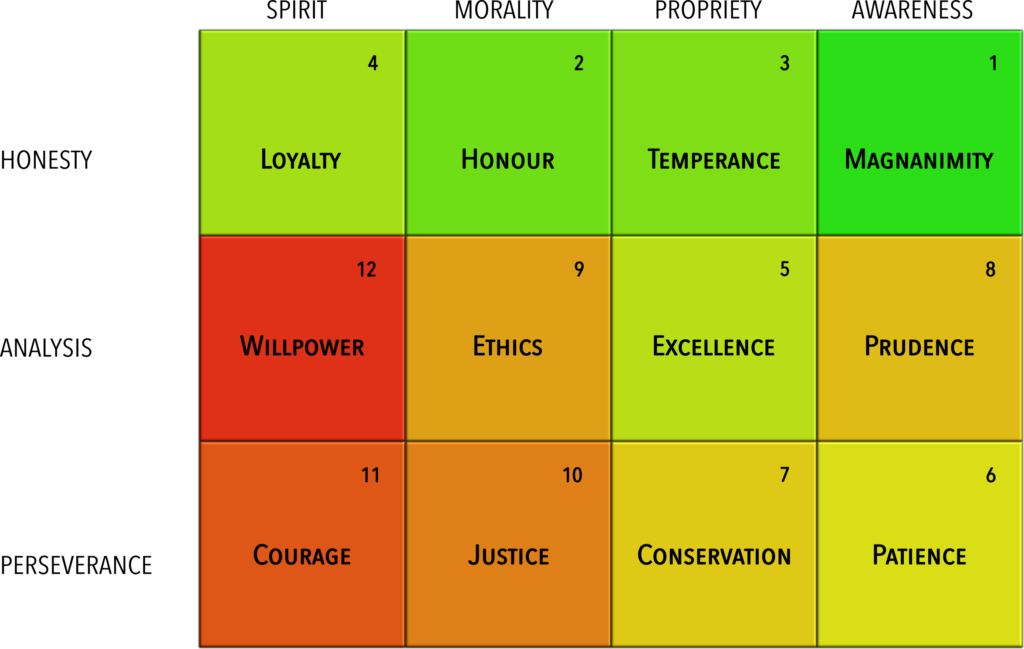
In Structural Virtues Theory (SVT), Greed directly opposes Conservation, which resides in the Perseverance aspect under the Propriety moment. Conservation is the virtue that allows us to retain Excellence, recognising that true wealth cannot be found in any material possessions but in the cultivation of virtue and purpose. Greed, however, is its antithesis: it is the refusal to value sustainability, leading to a cycle of excess and decay. To overcome greed requires the cultivation of Patience (awareness in perseverance), which, as implied, teaches us to see true wealth in the retention of the good things rather than the reliance on temporal and material rewards.
Problems in Conservation to do with Greed for Charlie are narratively tied in with the father. This is all very poignant and accurate in SVT terms. Charlie’s greedy actions are driven by a complex interplay of sins: Dependence, Envy, Hubris, Obsession, Disdain, and Amnesis. These sins all stem from a deep fear of scarcity, masked as the pursuit of wealth. His dependence on material success is more psychological crutch than economic requirement. The success drive is about justifying his actions and furthering the illusions of control at once feeding into one another, a Dependence / Greed (collapse / boon) cycle perpetually driven by an underlying desire for Delusional escape (Sloth). Envy of Raymond’s carefree life founded in this Sloth fuels Charlie’s resentment and drives the lack of appreciation/respect, while Hubris blinds him to the ethical consequences of his choices. Obsession with wealth compels him to manipulate others, and Disdain for Raymond’s differences becomes a tool to maintain his self-image as superior. Amnesis, literal and more deeply spiritual, the refusal to confront the truth of their relationship, allows him to justify his exploitation of Raymond’s gifts.
The Machinery of Materialism
The setting of Charlie’s greed is against the domain of Telos, where goals and purposes are pursued absent any concern for methods and with relentless intensity. His obsession with wealth is not merely a personal failing but a systemic flaw, a reflection of his society generally valuing material success more than moral integrity. In this context, Greed beads together like water molecules in collective delusion, perpetuated by systems that reward avarice and ignore the costs of unchecked solipsistic ambition meeting weaknesses in society and weaknesses in individuals with exploit.
Charlie’s initial acts of Greed are rooted in Dependence, as he relies on his ability to manipulate others, seeking stable security at first, then advancing into extreme risk as doing it for excessive gain. Charlie’s greed deepens, and it erodes the fabric of his relationships and friendships. His Hubris and Envy make him legitimise the theft of his father’s vehicle, feeling entitled to it, and deny his role in the falling out with his father. He doesn’t even have the Patience to talk with his girlfriend, or perceive her desire to be part of his life as valid, making her wait in the car during the funeral for his father, for instance. His interactions with Raymond are marked by a profound Disdain, which manifests in his refusal to acknowledge Raymond’s needs or even humanity. This disdain is enabled in a society which devalues those who do not conform to the builtin materialistic funnelling.
Charlie is tenacious in going after what he thinks he wants. His obsession with wealth leads him to exploit Raymond’s abilities for financial gain, alienating him and undermining their relationship. This is the true horror of Greed in Telos: the product becomes an illusion, while the process is a means to perpetuate it. The extremity of balances can convey the original evil, as Charlie’s pursuit of wealth leads to the erosion of his own moral compass. In equally extreme counter-point to Charlie’s hyper-Greed, Raymond cannot even understand the concept of money. This the money-obsessed takes for the most bitter-sweet of ironies since the money-ignorant inherits the father’s estate.
Relationships and the Illusions of Control
Trust is subverted wholly amidst manipulation atop trickery and leverage, where Charlie’s actions reach their nadir. His relationship with Raymond is a confrontation with his own Greed itself in forced Patience, while he treats Raymond as a means to an end rather than as a person. This manipulation is justified by his Hubris, the belief that he can control all outcomes through sheer willpower and enough “liquidity.”
Raymond’s character is an antithesis of both Conservation and Greed: unburdened by accumulation or even the concept of money. Raymond is unfazed by the grind of daily life as a struggle for the many seeking respite amid all the materialism, or even the basic needs of life; equating needs to rigid routine. His ability to perform complex calculations, count many objects at once, and his difficulties in communication demonstrate an altered connection with reality and others.
Charlie’s own relationships are disrupted too, but by his basic difficulties understanding the point of reality, and others. Charlie is as at variance with reality as Raymond, but for different reasons. Everything after his break with his father became about his not getting what he believed he deserved, and this envy to dependence to greed cycle escalated from that point on.
“Reasonable” Lies
At first amazed by Raymond’s special abilities then designing, Charlie implements a warped and deceptive logic to justify his exploitation of Raymond. He takes his brother away from the only home he’s ever known, for the purposes of getting at the inheritance in someway, however he could. Raymond’s abilities are used as a means to cheat at gambling and feed Charlie’s lust for material wealth, framing his actions as necessary for survival rather than as moral failure. He makes himself dependent upon his brother, but not in any brotherly way. He justifies the manipulation of Raymond with the loss of inheritance and then his awaiting business dealings.
The story conveys the progress from justification and manipulation to the beginnings of legitimate patience founded in spiritual valuations. Ray tries Charlie’s patience, which makes the dependence all the more difficult. The progressive development of Patience plays out through scenes in which Raymond has necessary rituals, cannot get on a plane, needs to leave the car when witnessing a crash, and being unable to leave the motel when it is raining. Charlie develops Patience slowly, moderation which allows some respite from material desire and enables the cultivation of Conservation, where it is strengthened in spirit, spiritual Excellence and Loyalty most.
Through his interactions with Raymond, he begins to see the first shreds of something beyond the illusions of wealth and recognise the value of human connection. His formerly disfunctional dependence on his father now shifts toward a growing bond with his brother, and a more genuine one with his girlfriend. Charlie’s journey is a representation of the broader struggle against materialism for mankind. Just as he is getting over something in dependence, leaning away from greed and its delusions as well, he is pushed back in by the failure of his business while being forced to drive across the country with Raymond.
Patience, as the virtue opposing Greed, demands a careful humility: acknowledging that no individual could possibly hold all the answers and that the order behind honesty-fuelled Excellence requires consideration and deserves time. Everything that Raymond was, and all that he accomplished despite his limitations was due to great patience. Conservation, as the second virtue acquired in the aspect of Perseverance after Patience, is the necessary foundation for ethical and moral growth.
That Conservation deriving from the dynamic encourages Prudence which is the bottom of the backbone preceding the completion of the Morality moment, in Ethics and Justice. True power is perfectly in service and never exploitation, but this is a difficult hurdle for materialists, made all the more difficult for conservationists as well by them. The order arising from the collapse of Greed and the dawning of the first moment completion: Propriety. This is the necessary rooting in traditions and wisdoms that enable the readjustment of Analysis through the defeat of Delusions which ultimately opens the path to God’s Will, like a slingshot constructed out of the final five virtues. Charlie is yet far from this, he’s not even close to mastering the virtues leading up to Patience or conquering Greed. We see baby steps in Charlie, most especially in the first virtue, Magnanimity prevailing over Amnesis, a process helped most by the Willpower of those more advanced in the virtues.
The Light of Patience
The film reveals a view upon the transformative power of Patience and Conservation. Charlie’s reconciliation with Raymond is a preview through that redeeming initiation of persevering in self-awareness, in all it cost you to arrive where you are, not in material terms but spiritually. His journey through patience overcoming greed is nascent at best, and primarily informs developments in loyalty and excellence. He has quite a few more lessons before arriving at the reality that the greatest wealth could not be in material accumulation but in the cultivation of virtue.
Unbridled avarice is deadly to society and the transformative power of patience and conservation. The structural virtues offer a pathway to more reasonable and valuable outlooks on the world, grounded in ethical discernment and responsibility. Charlie knew he could not care for all Raymond’s needs. He had to accept that. It was also important that Raymond stay in the home he was most accustomed to, and that this was what was best for him, regardless any new found emotional bonds or desire to steer the estate.
Materialism dominates, so we are all called to ask: what is there to do? Do we head in the direction Charlie was headed, or do we cultivate greater value within? Do we accept the illusions in material power and the lies of its master, or will we act with courage toward Truth?
Leave a Reply