
Statement of Non-Denominationalism
Clarifying Stances
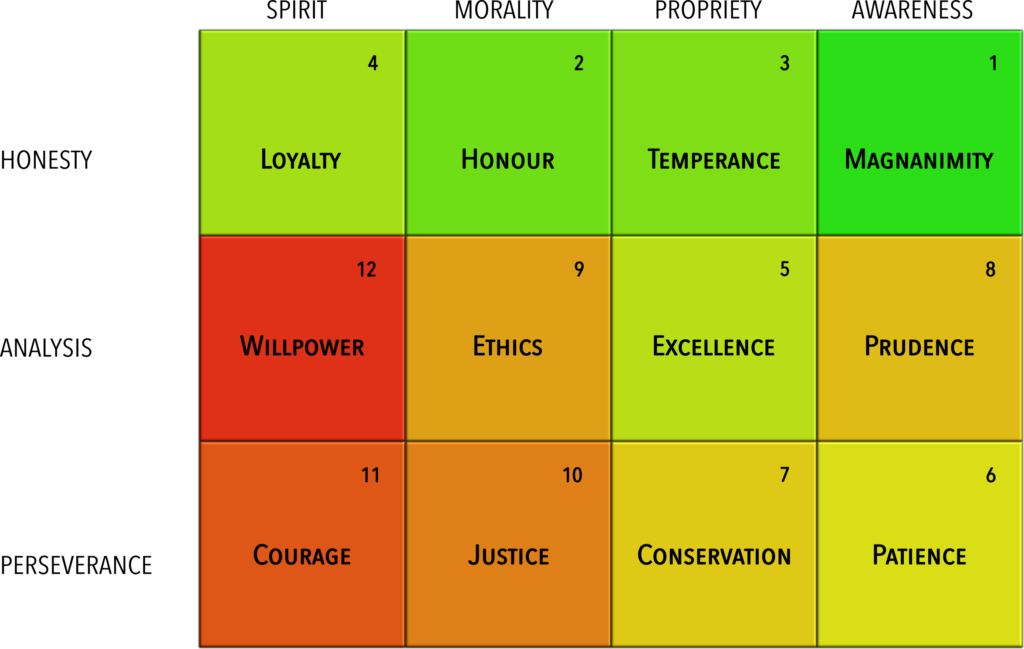
I am sometimes asked where I “fit” denominationally. The honest and simple answer is: I don’t and cannot. This is deliberate and purposeful for my mission. I must be in communion and of service to all. Denominations are not evil. They are formations around unanswered questions. Catholic magisterium and apostolic succession offer questions based in authority. Eastern Orthodoxy offer questions of theosis and beauty of depth in relationship to Christ. Reformed traditions offer questions of sovereignty against depravity. Charismatics offer questions of the immediate power in Holy Spirit. Every tradition crystallised as responses around genuine gaps in understandings, but then, all too often, many mistake a partial answer assistant to some questions for the whole answer to all questions. My own work in Resurrexit Spiritus (RS) phenomenology, Structural Virtues Theory (SVT; the Diligent Dozen), Spiritual Selection (evolutionary psychology of spirit and attachment), First Other developmental theory, and Manteic ontology, grew up around a different set of questions:
- How does the Holy Spirit actually operate in the psyche, moment by moment, motivation by motivation; strength to strength and virtue upon virtues as against the errors and sins? How do extremes, moderations, and lessons contribute to this, as hinted by parables such as the prodigal son?
- How do we structure virtues conceptually so they best fit the spirit as armour against the demoralisation, materialism, and reductive hubris now choking the West with ever more deceptive layering of materialisms? How do we best mount a challenge and defence against transhumanism?
- Logos directs individual regeneration, 100% but also all creation, meaning the very selection pressures that shape human spirit across generations, as imperfectly perceived in genetics, so how does this not apply to our understanding of the depths in Logos and our place in creation?
- How does the theological shape of God, the Father, and Jesus the Son affect our understandings of socialisation and intergenerational spiritual debts which play out from the sins of the father to the sins of the children?
These are outstanding questions offered with a struggle to answer them pursuant throughout my work. My inquiries sit at the living edge where scripture, psychology, philosophy, evolution, genetics, and the observable dynamics of Spirit meet, providing a space of the unseen unmapped and yet undefined in the public consciousness. I humbly submit answers, however imperfect and improvable down the line.
This is why I operate independently under the broad umbrella of scripture-rooted and yet philosophically robust Christianity. The point of independence here is not about pretending to be “above” any denominations. I offer questions and answers to the greater body of Christ, across denominations as equally as possible, in hopes of opening this discourse to as many as possible.
This all indeed demands seriousness, yet I refuse to let any of these answers or questions mutate into new legalisms, or become tied down to any of the extant sets of questions offered, as I view these questions applicable to all; underlying not overbearing. I draw freely from the Church fathers, philosophy, and various wisdom texts (read through an orthodox lens). I critique out of love for the living Body of Christ, the whole. I believe pride in a label has no place when pride in Christ is everything, and indeed the only permissible pride. This is the breadth I want you to see here: I am traditional yet radically protestant in methodology (direct access to the Father through the Son, the regenerative power of the Spirit now, and freedom from institutional gatekeeping).
On Evolution and Spiritual Selection
I do not reject evolution. I view the majority of recent human advancements through the lens of Spiritual Selection taking up progress. Simple materialist evolution which only recognises “natural selection” pretends that this more primitive and animalistic process can explain the unqualifiable amount of progress and even the ascent of Spirit recognition in humanity alone (ignorantly preferring to see it all as hallucination): all tightening consciousness, attachment, and virtues explainable by raw advantage, without room for the eyes of spiritual discernment.
That is reductive hubris. What we actually observe across human sciences (psychology, sociology, developmental biology, mate selection, and cultural history) is a process mapping over an operable blueprint built into reality: the Father as ultimate other, the Logos as that which pulls spirit upward, and the Holy Spirit as the regenerative intentionality that promotes pro-social, life-affirming traits in all. The deeper story of humanity is an evolution of the connection to the present and extant Spirit, Holy and origin of all life. Evolution of the body is assuredly real, and primarily driven in the animal kingdom by bare natural selection, yet also around reality-based blueprints built into the fabric of energetic Life, individually deriving from Spirit; seen only through the chemical bodily residue of unseen workings as source of the very energy of life. This is no stretch, as even all material is energetic. All energy derives from God, and creation is constant through our Lord.
Communities that orient toward the Logos thrive; those that choke it with greed, demoralisation, or false voices wither. This could not be random. It is the quiet, sovereign work of the same God who raised Christ and lifts the deadened in spirit today. What is described in the Resurrexit Spiritus phenomenology is heavily symbolic and descriptive of mechanisms in the lessons of human life and experience.
If you are any Christian who loves both the Bible and rigorous thought, this framework is for you. Let the nihilism of many evolutionists miss you, and adopt a wider comprehension of creation which you take instrumental part through Jesus, Logos, and Holy Spirit.
The Impossibility of “Non-Bias” in Science: Spiritual Snake Oil and Why Life Demands a Virtuous Bias
Modern scientism sells the myth of “neutral,” “non-biased” inquiry. It is a lie. Every scientist begins with presuppositions: about whether the universe is intelligible, whether life has intrinsic value, or whether Truth is worth pursuing even when costly. Pretending otherwise produces a scientism as answer across the board for these questions: intractable and unscalable abyss of denying the higher self for the sake of the material self; a selling of the soul if ever there was one in foregoing of deeper spiritual Truth. The best such mindsets can hope for is “mere shadow cast by the light of the greater divine wisdom” (as I have written elsewhere).
Reductionist psychology outside Spirit (chemical/materialist/”monkey-brain” explanations for life and thought), materialist evolutionary theory inductive to nihilism, and value-free ethics all collapse into the same dead corpse: a cold universe without Logos; without the Light. Virtues Science openly declares bias for Life. Bias for the regenerative power of the resurrected Christ. Bias for the lived strengths that armour the soul against the night of godless beliefs.
This is necessary philosophically-informed intellectual honesty. Science that studies life cannot be neutral about life; Life. We must choose: either God’s Holy Spirit as the source of all life or the void that ultimately explains nothing and can deny no abuses.
St. Augustine and More Clarity (optional)
If asked for more precision in definitions, my work is something of a modern extension to Augustine’s core project: mapping the lived phenomenology of the human spirit’s ascent under Sovereign Grace, integrating the best of philosophy and reason while refusing to let either choke Logos, and the more vital aspects of the discourse.
Augustine gave the Church Confessions and De Trinitate: inward, psychological explorations of memory, will, affections/understandings/intellect, and the soul’s dynamic movement from disordered loves and material bondage toward ordered Love of God. He analysed how Grace regenerates the inner man, turning the heart from extremism and false securities to wholeness in Jesus. Resurrexit Spiritus takes that same introspective rigour and expands upon it with answers for more modern challenges to the workings of Grace. He, like me, traced the mind’s triadic structure as imago Dei; image of the triune nature in God, showing how Grace reorders affections from material bondage to Love of God, quite identically in shape to my own work which I centre around lessons in extremes and moderations. The triadic in RS is present twice. It is in the aspects of reason as foundational to SVT: Honesty, Perseverance, and Analysis; as well as the lower domains capitulated in Logos: Kratos, Telos, and Eros.
Augustine described stages of ascent from carnal to intelligible to divine, and I delineate four elevations in motivational domains (Kratos → Telos → Eros → Logos) reformed from Reversal Theory, designing upon the moderation in discourse and wrapped in Hegelian dialectic. These are abstracts representing real structural, hypothetically testable realities of Spirit and inclinations: primitive confrontations to conformity (hylic foundations), productive craft, relational definition, and finally mastery/power/Love through the Logos, the “mirror reflecting an overriding summary or reconfiguration of the preceding three domains.” Psychomena (reasoned evaluations of the greatest good appearing as beauty) and manteic ontology (balanced deep thought coordinating conscious and subconscious) operationalise what Augustine called the inner dialogue of the mind turned toward greater levels of Truth; the ultimate moderations.
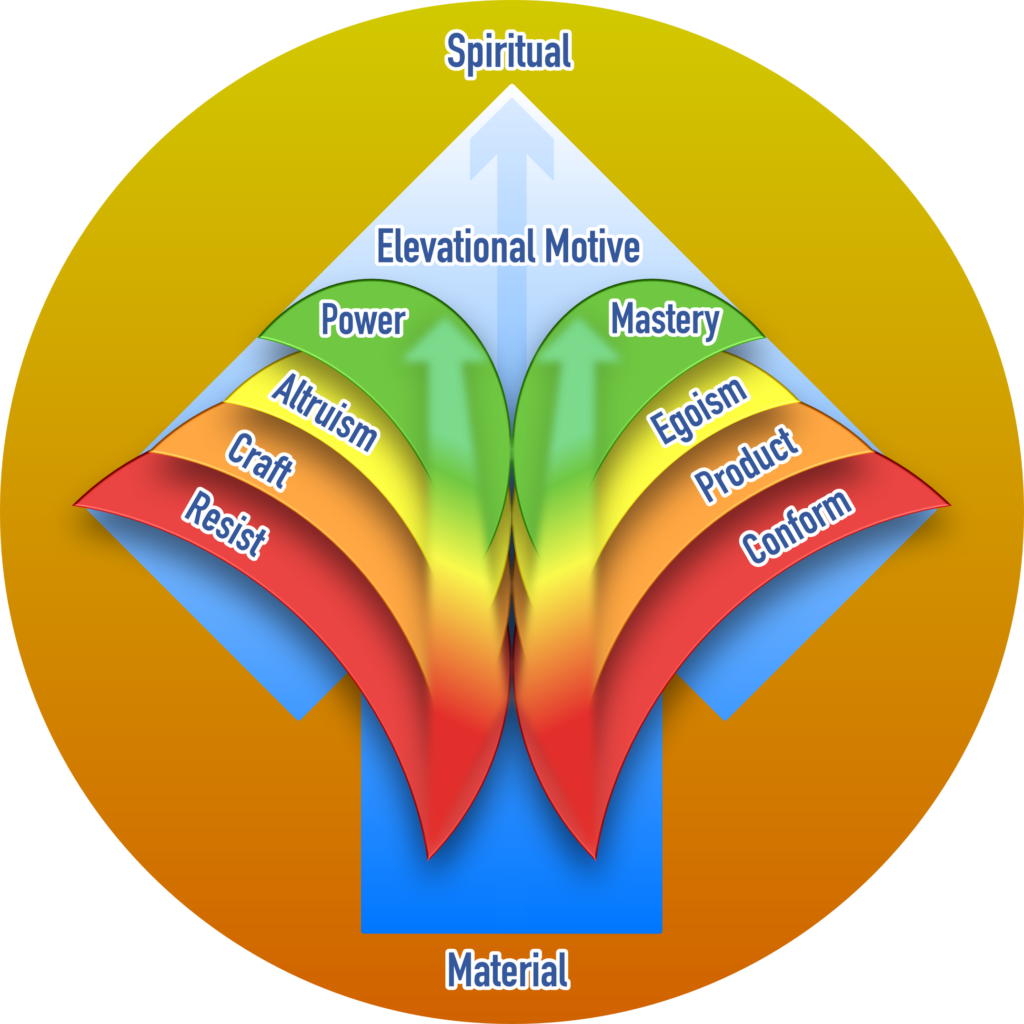
Power <-> Mastery
EROS (yellow):
Altruism <-> Egoism
TELOS (oranges):
Craft <-> Product
KRATOS (red):
Resist <-> Conform
The elevational motive (Hegelian in structure yet Christ-grounded as ascendant in denial of the lower self) derives from the regenerative intentionality of the Holy Spirit, and correction in Logos opening up pathways to greater Goodness and God: resurrection spiritually in this Life is necessary yet made possible through comprehension of Truths through moderation from discourse, an arising from the dead in this very life. I define Spirit as life led by Love, and human spirit as Love of God, and the universal Good in humanity insofar as it can reflect God.
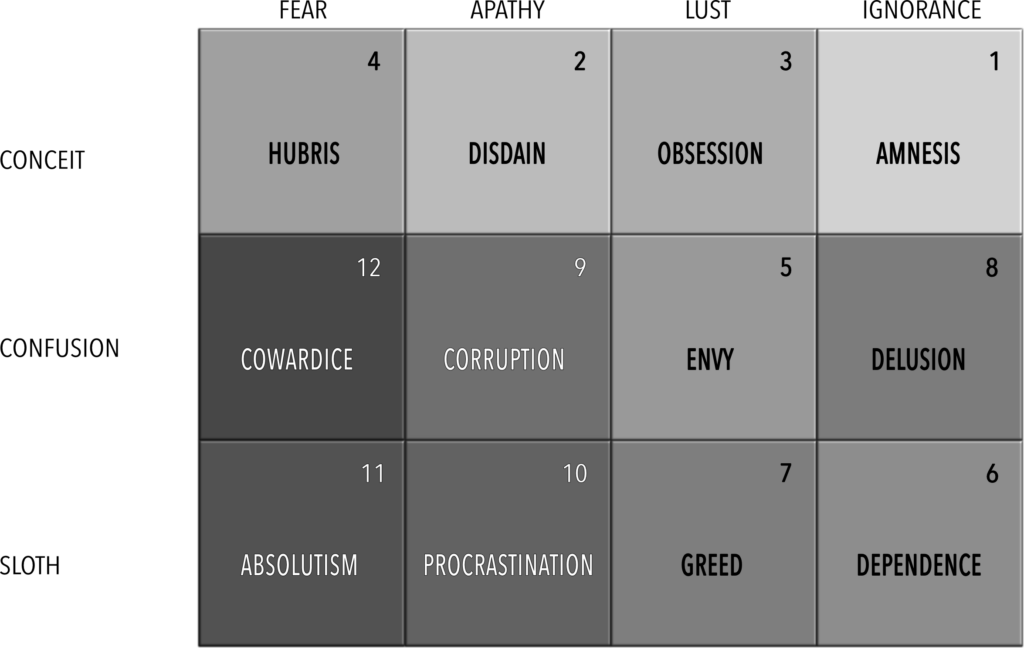
The Structural Virtues Theory (the Diligent Dozen) extends Augustine’s ethics of ordered loves into appropriately wearable armour: twelve skills in Reason, acquired across moments of awareness, propriety, morality, and spirit, shielding against the “Dirty Dozen” sins of demoralisation that choke the Logos exactly as Jesus warned (anxieties, deceitfulness of riches, other desires). What is provided is virtues as structural reality, which is precisely the kind of concrete sanctification Augustine longed for amid Rome’s collapse.
Spiritual Selection and First Other Theory push further into territory Augustine could only gesture toward. His doctrine of rationes seminales (“seed principles”) planted latent potentialities in creation at the beginning, allowing forms to unfold over time under God’s sovereign causality, not blind chance, but directed development. My work frames observable evolutionary dynamics of apparent genetic changes as something elevated at the outset of man matching what makes us the image of God (mate selection for pro-social traits, paternal attachment as civilisation’s engine, outmoded instincts displaced by cognitive/spiritual modules) as the quiet work of the same regenerative Spirit. Fatherhood as “First Other” reordering in attachment models God’s Love in society and acts as transmission personality, internal reflection; absence of a moral father (and therefore without natural initiation in the Father) breeds the very demoralisation Augustine diagnosed in City of God. Science in RS is read through the proud bias for Life that Augustine himself demanded: reason must serve Truth, never pretend “neutrality” which amounts to denial of Spirit and falls to the lowest common denominator in the highest material bidder.
In short, Resurrexit Spiritus does for the modern shape of psyche, psychology, and evolutionary science what Augustine did for late-antique philosophy amid crumbling empire. I have constructed rigorous and lived tools for helping us reconcile the revelations in modern discoveries with the realities of our faith. Augustine was a bishop who, after battling Donatists and Pelagians, came to see the visible institutional Church and its sacraments as essential guarantees of understandings in Grace across a fallen world. He emphasised efficacious, even irresistible, Grace within the Church. RS locates the regenerative work of the Spirit first and foremost in the direct, phenomenological encounter with the present living Logos in logically comprehensible terms, to those who may see the workings of Grace but not know its source, or might otherwise be in denial.
I give it up to the Church in entirety, across denominations (and even to the heresies or corruptions, in greater hopes for their restoration) to the humble priesthood present of all believers most especially elders in faith, without invoking any gatekeeping institutions. I do not invest the same confidence in visible structures that Augustine did, and perhaps was forced to in his day in order to reach the flock. He might well rebuke me for insufficient emphasis on the visible Church’s role in safeguarding orthodoxy and promoting Jesus. However I would argue few ever perfectly accomplished both of these in balance and that we now live in a different world, where Christianity is so ubiquitous that even most atheists and “pagans” are unknowingly indebted to Jesus.
Augustine integrated Hellenistic philosophy (especially Neoplatonism) after rejecting Manichaean dualism, but he understandably became wary of philosophy’s excesses. I similarly critically draw from philosophical traditions as well: Hegel’s spiritual phenomenology and dialectic, Epictetus’s stoic moderation, and even texts like the Gospel of Truth. My freedom to synthesise without a magisterium would amuse him and I believe he would agree with many of the decisions made in the constructs.
On evolution itself, Augustine’s rationes seminales beautifully prefigure a directed, God-implanted unfolding of creation. I extend this into Spiritual Selection without apology. Yet Augustine did not anticipate modern mechanisms and despiritualising/demoralisation processes in scientism. Shocked by everything that is scientism and its materialistic demands, he might question whether my work risks over-accommodating them, with its current ridiculous overreach, even as he would celebrate the anti-reductionism against their absolutist cutting off of all things in Spirit. I do not think it does, and believe I accommodate questions in modernity just enough to help those trapped instead capture every thought and turn it toward Jesus; Logos. Augustine’s mature theology leaned heavily toward predestination and the irresistibility of Grace. I rely on the irresistibility of Grace as much as Augustine, perhaps moreso. However, his reliance upon Grace sometimes minimised (perhaps in necessary reaction to Pelagianism) the felt phenomenology of ascendant (elevational in RS) motive and balance across domains. My framework insists all progress remains Grace-enabled yet maps the lived, motivational texture of that elevational Grace with precision so that it might be more readily recognisable to those on the path (with many quite nascent in the Truth whom do not know they are on any path as cut off “intellectually” by the claims of scientistic authority), assisting in conceptions of their next steps.
TL;DR (too long; didn’t read?)
The differences between Augustine’s work and mine are mostly due to their purposes and environment: his constructing orthodoxy amid manipulative empire (that empire clinging for scraps of power) versus my seeking clarity of growth processes in spirit against an age of growing materialism; arisen Babel of transhumanism. Both of us say the same thing in the end: Logos is the resurrection of the only begotten; so Jesus alone saves, regenerates, and elevates in the fruitages of God’s Holy Spirit. Same banner, same purpose; yet against different types of tyrants in ages at variance.
Who I Am Writing To
I am writing to all people, including atheists and every Christian: denominational Christians of all stripes, non-denominational evangelicals, Spirit-led Protestants, house-church thinkers, cultural apologists, and Christians in academia who sense that the Gospel must confront the modern materialistic reformations of psyche and the problems posed with greater precision than ever before.
You already know the institutions are imperfect, as are our received texts. You already feel the pull of the Logos beyond party lines, or denomination. You want philosophically rigorous spiritual orthodoxy that is alive with the tradition, intellectually stimulating, and ascendant in the Lord. Come. There are no perfect people, nations, or denominations, only a perfect Saviour and perfect plan from a perfect Father. My work is offered in service to Him, and to all.
If you seek philosophical depth and are weary of Christian thinkers who either (a) reject science outright or (b) baptise and repackage materialist assumptions with a thin coat of “Jesus-language,” this page, and the entire 24K project, is written for you (to learn where my views diverge with the “existentialist” likes of Heidegger and Kierkegaard, read this series: Existentialism as Babel Tower). If these ideas resonate, please explore the SVT Diligent Dozen, dive into RS phenomenology, read some of the articles here on virtues.blog, or check out a perennial issue of the 24K Journal. If you would like nearly 500 pages of community strategy, with homework, I recommend my first book at YourFight.Club. I also recently published a novel called Gobland based heavily in RS and SVT, available on Amazon and other retailers or at AuraPura.org.
The Spirit is moving, so we elevate together!
Live Well,
Dr. Marcus Roe
virtues.blog | 24K Journal of Virtues Science (24k.cc)
Jesus est Rex Regum, Factor Semitae! The whole club is Christ’s, we’re all just in it.
Dr. Marcus Roe is a research psychologist and philosopher who earned his PhD in Psychology with a quantitative statistical dissertation examining evolutionary and social psychology, including matrilateral biases in family relationships, disconnecting it from paternity uncertainty. As founder and editor-in-chief of the 24K Journal of Virtues Science, he has developed original integrative frameworks around Christian philosophy. The work bridges cognitive phenomenology, evolutionary concepts of personality and spirit, virtues ethics, and cultural analysis to provide practical tools for inner regeneration and resistance to modern reductive materialism. He also hosts the Touch Grass show, which explores grounded, life-affirming living in alignment with God’s designs (Episode 1: https://rumble.com/v728uqo-touch-grass-episode-1.html; Episode 2: https://www.youtube.com/watch?v=v99I_K-8JlM). Operating as an independent thinker, Roe publishes through virtues.blog and related platforms while serving as a cultural consultant and executive director of American Cooperatives Institute / AuraPura Publishing, nonprofits founded in 2021 dedicated to rigorous and lived approaches to human spiritual flourishing.