
How Corruption Binds Us
Who can see through the veil of power maintenance, and its delayed Justice? Spotlight, the 2015 film portraying the heart-wrenching true story of institutionalised child abuse, is a chronicle of just such heroics; it is a mirror held up to the rotting corpse of these institutions that abuse the name of Christ, that have long thrived on Confusion, Greed, and the quiet complicity of Dependence.
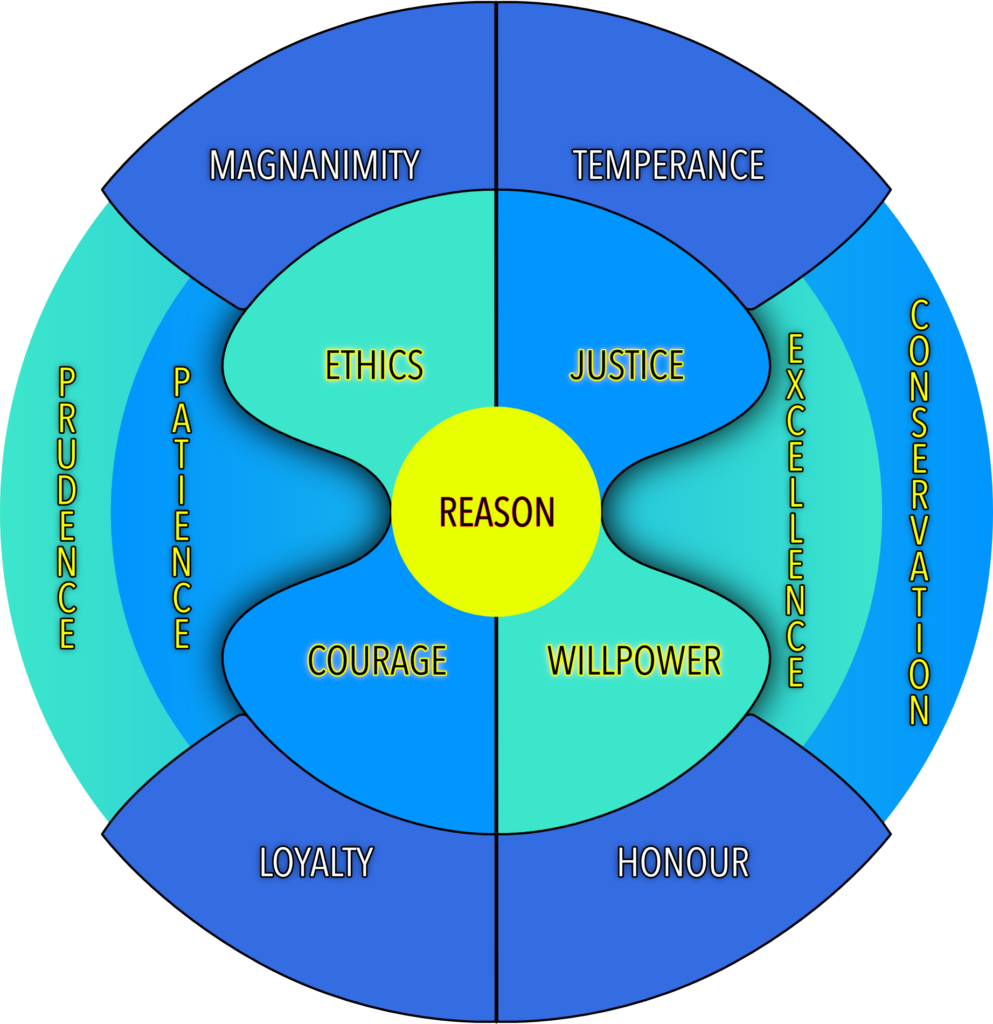
This is a story of how Corruption arises not from the chaos in itself, but from the deliberate cultivation of lies, systematic erasure of Truth, and seductive illusions of control amidst it, that foments this chaos most. The Vatican and parishes all rise and fall with control over their priests, and the more skeletons which pile up in closets everywhere, the more opportunity for expansion of the most cynical forms of control. This movie is a tale of how Prudence (armed by preceding virtues of Conservation, Patience, Excellence, and Loyalty) can drive the pursuit of Justice against Corruption and dismantle even the most fortified walls of power built off Moral decay (in SVT). This is our step into Ethics, and the first into a more Just society.
Illusions of Control
The first domain in Resurrexit Spiritus (RS), Kratos, is where societies begin to define themselves through the acceptance or rejection of rules, and thus set the destiny of all communal power. In Spotlight, this is embodied by the Church’s interface with the domain through its intricate web of institutional rules, which are used as instruments of suppression and blackmail as much as guidelines. This is normal for Kratos domain, a difficult balance for avoidance of abuse. The bishops, cardinals, and clergy, however, do not all seek balance, and certainly not those most materially benefited inside, which is to say the most materially driven and thus “powerful” within organisations having currency in material power.
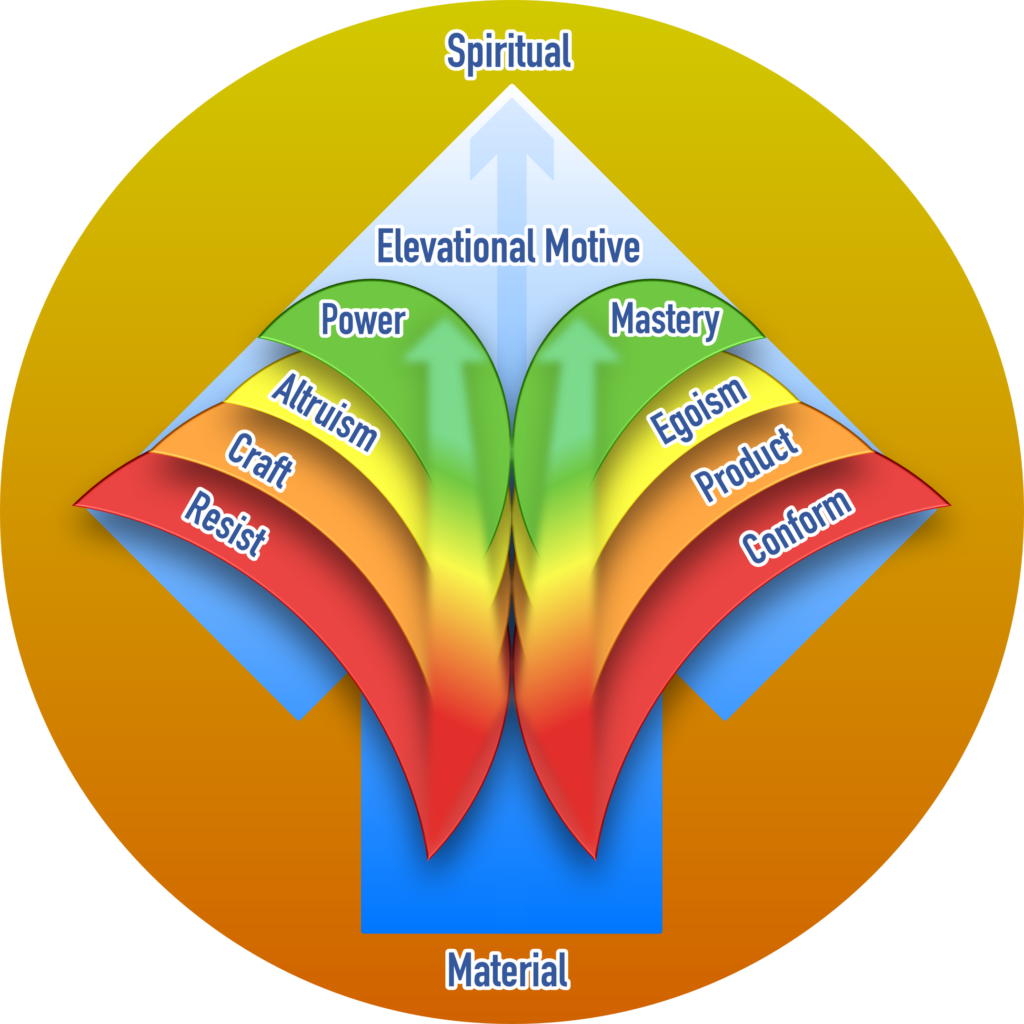
Power <-> Mastery
EROS (yellow):
Altruism <-> Egoism
TELOS (oranges):
Craft <-> Product
KRATOS (red):
Resist <-> Conform
The film opens with a scene from the past that encapsulates the quintessence of extremity within this first RS domain: two police officers casually complying in remaining silent in the dismissal of arraignment in the an arrest of a priest. The mother is assured by clergy that this priest will be “removed from the parish,” while an assistant district attorney urges the officers to keep the arrest secret. Here, we witness the first and most visible expression of corruption where a system not seeking after Justice, instead seeks to protect ‘its own’ interests. Whatever rules being implemented here are designed to silence truth.
The corrupted rule-setters operate a system demanding silence, secrecy, and preservation of institutional authority above all other things, certainly over balance which is simply another factor of stability for their authority. Rules, in such extremities of Kratos, are then turned toward sharing power and avoiding accountability, burying truths, and maintaining dominion. It is always extremes that balance other extremes in RS, whether toward sin or virtue.
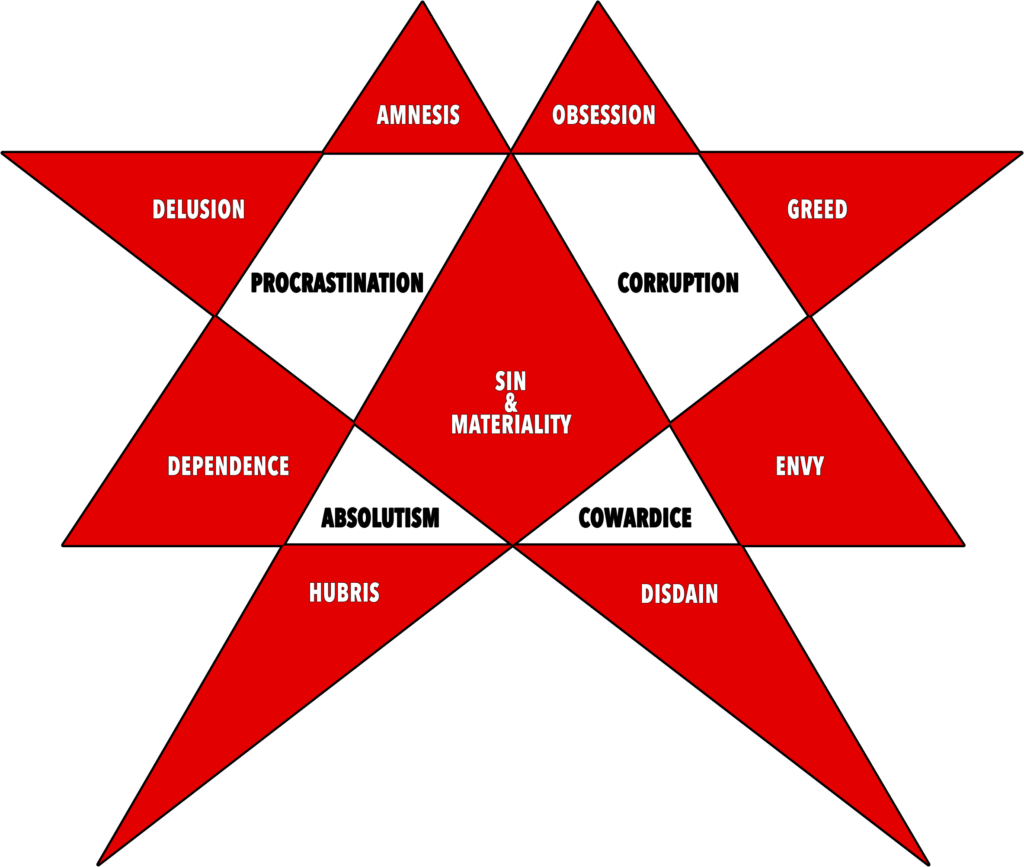
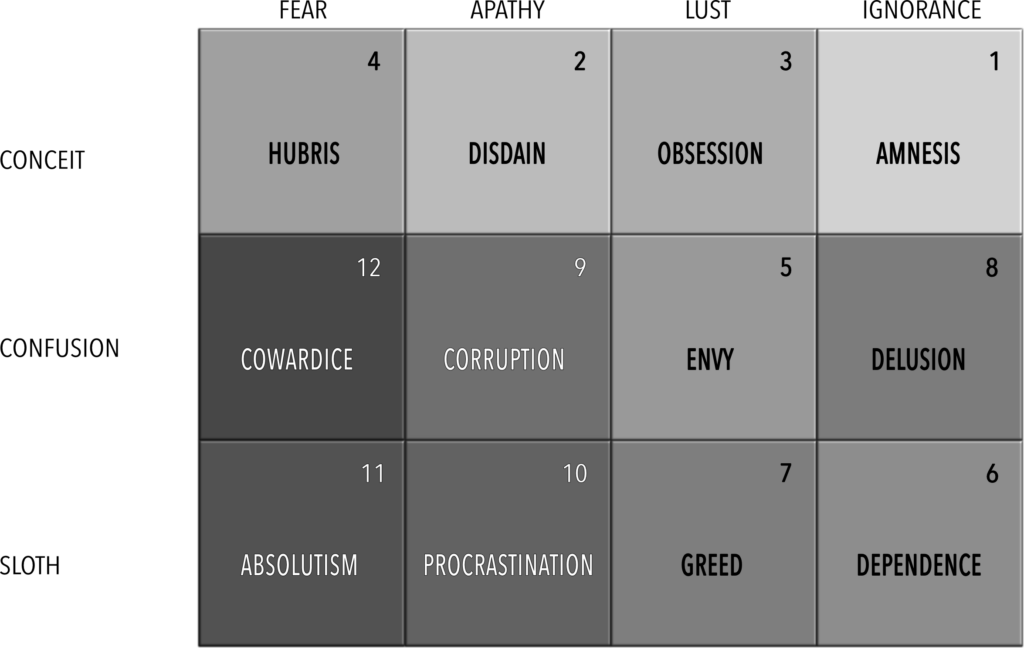
This is the deconstruction of balance in Kratos, with the belief that power stems from the ability to actively rewrite reality. The Church’s response to abuse is not to properly confront it but to reassign priests, obscure evidence, and suppress victims’ voices. This is calculated disorder, built on cultivated Delusion and the Corruption of Truth, blocking the way to God’s Willpower like a filter on all Analysis. The bishops Fear exposure because all the silenced scandals have become opportunities to reinforce their authority through crisis management between priests and in their own Procrastination, Absolutism, and Cowardice.
Outcome and Method
In the next domain of Telos, off this extreme non-foundation through Kratos there will be need for a corrupt organisation to balance their product (the tangible outcome) with the process (the methods used) amidst complete disorder. The product of their efforts as overriding goal for those who rise within, the maintenance of institutional power, is achieved through a process that is not only unethical and Corrupt, but only as deeply destructive as the clergy is trusted. We thus find extremes in both sides of the RS balance in Telos, balancing where it is completely unnecessary (due to the imbalance below). This imbalance follows through for all whom act in Apathy and then Ignorance, wilfully as lost in Confusion.
“I was doing my job.”
“Yeah, you and everyone else.”
The investigative team uncover an entire system protecting predators, while ensuring victims remain silent. This is the true nature of Telos in Corruption: the process becomes a tool for obfuscation, and the product by proxy, so that this horrific veneer against the fraudulent stability becomes a prison of our own societal making. There is a reason there is so much depth here to comprehend, dawning on Ethics toward Justice, since the overcoming of this sin of Corruption involves the reconfiguration of our mirror of Logos within itself, but more on that in a moment.
The Church’s response to the revelations is not one of remorse but of constant calculated resistance. They deploy legal loopholes, threaten lawsuits, and manipulate public perception. The bishops, in all things, seek control: over the narrative, the victims, the grateful priests, and the parishes. The Church values these bishops on their ability to maintain or expand control. This is where Telos becomes a weapon against the Body of Christ: the product (the appearance of order) is maintained by erasing the process set against the heart (the truth in mass abuse).
The Myth of Shared Victories Outside Lord Jesus, Governor Over All governors
The most insidious form of Corruption here operates in the Eros domain, where relationships are not built on trust but on manipulation. In Spotlight, this is evident in the Church’s ability to maintain the Loyalty of its members through a combination of Fear and shame or guilt through Dependency. The caught perpetrators of abuse are claimed as anomalies, “bad apples” that must be quietly removed… to another parish, beholden more than ever to the hierarchy. There is no Victory in Christ here, and cannot be any.
The film reveals how the Church cultivates a culture of Dependence: parishioners are taught to trust their clergy without question, while priests are given all the tools to manipulate their own communities, while the most manipulative rise to the very top. If only this was mere hypocrisy; it is a system of Satan and evil designed to ensure that no one challenges the status quo, and full-stop corrupts Justice. The clergy constructs a new reality amongst themselves in which victim’s suffering is unrecognised and secondary to not even institutional survival in itself, but mere careers and personal power sold as institutional survival to the sheep who are asked to look away.
The most tragic aspect of this domain is its ability to render individuals complicit in their own oppression. When the Spotlight team confronts Cardinal Law and his allies, they find not enemies but people who have internalised the Church’s values so deeply that they no longer see themselves as villains. This is the true horror of the domain Eros in Corruption and unbaptised: the enemy is not a single figure but an entire system that has turned its victims into collaborators, and set love against itself.
“Reasonable” Deceptions and High Lies
The most sophisticated form of corruption occurs in the Logos domain, requiring the previously discussed reconfiguration for expansion in Ethics. In Spotlight, this is exemplified by the Church’s use of legalities and public relations campaigns to forestall revelation and the onset of Justice. The bishops do not deny the abuse; they reframe it as matters of “complexity” or about the abuser’s salvation primarily. This is the final act of Deception: making the lie so unconvincing that it becomes necessary for the sheep to shut off logic and reason to accept the newly supplied lie as truth. In actual Truth, the abusers should not be clergy, at least.
The film’s turning point comes when the Spotlight team discovers a letter from Bishop John Michael D’Arcy warning Cardinal Law of the priest’s abuse beforehand. This document, which should have exposed the cover-up, is instead excused as ‘evidence’ of the Church’s unfortunate ‘complicity’ given the ambiguity of the situation. The bishops do not seek to confront the truth; they seek to redefine it on their own terms just as the abusing priests do, as all abusers do. This is the essence of Logos in corruption: the ability to shape reality through falsified reasoning, High Lies, ensuring that no alternative interpretation is ever allowed to take hold.
Yet, in Logos, there is the most powerful resistance: VIRTUE. The investigative team, despite being told to “keep quiet,” refuse to comply. Their meticulous research, their refusal to accept the Church’s narrative, their ability to question even themselves, being careful with who knew as they investigated, and their commitment to exposing the Truth are all prime examples of Prudence in strong form: armed well with Conservation (the need to conserve love and innocence; careful preservation of evidence), Patience (the willingness to wait for the right moment; careful persistence), Excellence (the pursuit of accuracy over expediency), and Loyalty (to the victims, not to the institution). Such behaviour alone empowers Ethics, Justice, Courage, and Willpower throughout society.
Corruption Feeds on Dependence and its Silence
At the heart of Spotlight is a simple truth: Corruption thrives on Dependence through Delusion and Greed, with the lawyers in the cases creating a “cottage industry.” The Church’s ability to maintain evil power is not due to any strength but to the weakness of those within it and weakness in disordered community allowing it to persist as drowning in it. Corruption not only thrives in, but is cultivated through all the Dependency, the Greed, and the Delusion. This is why the Spotlight team’s investigation is so “dangerous,” because it threatens to unravel the entire foundation of material and sinful power.
Vigilance Breaks the Cycle
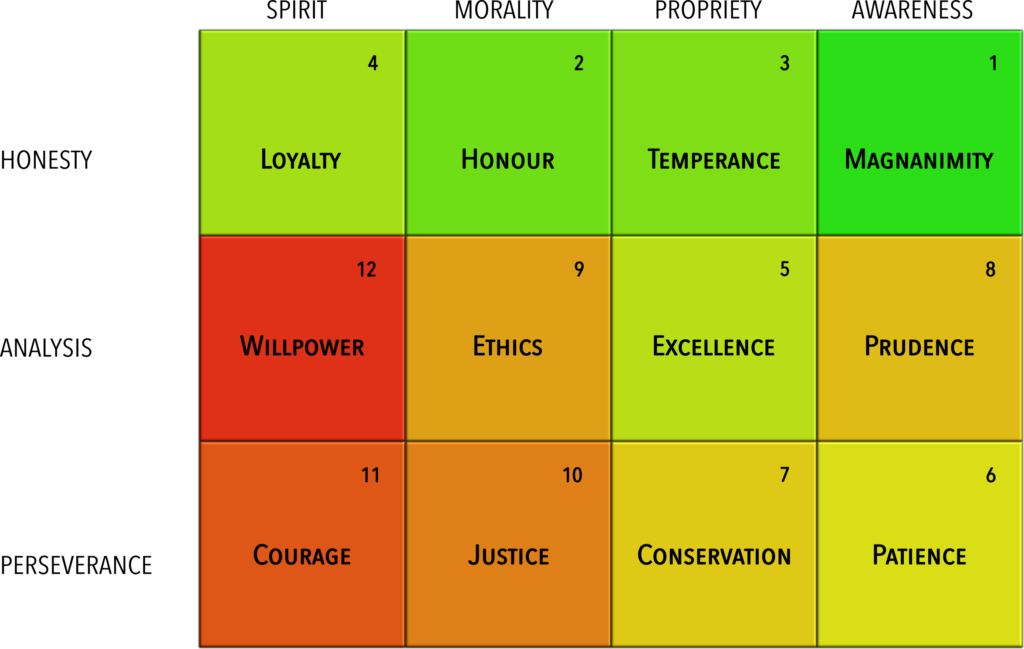
To combat Corruption, one must first recognise it for what it is: not a single act of wrongdoing but this sinful system built on these other sins. In Spotlight, the investigative team exposes the abuse yet dismantle only part of the structure that enabled it. Their success is primarily due to the cultivation of Prudence, at the aspect of Analysis in the moment of Awareness.
Prudence is a more active and care-based engagement with reality, as enabled off the heels of Conservation at Perseverance in Propriety. It is the ability to see through the illusions of power, to resist the seductive promises of comfort, and to act with integrity, especially against systematic horrors. This film forces viewers to mentally reckon with the system that not only enabled mass abuse but used such mass abuse for maintenance of evil power based in corrupting the very Body of Christ. It all remains still unchallenged, in the Church and elsewhere.
Action
The Spotlight in this film was most upon the nature of power, sins in society, and complacency’s cost, as well as how this trifecta feeds into each other and itself. The most Corruption does not arise through chaos, but riding atop it; promoting it, with quiet erosion of truths in dark corners, the systematic cultivation of sins wrapped in lies for power, and the expansion of exploitation. So, knowing all this, in a world with silent machinery of control all around, ever-turning, what will we do? Will we accept this, or will we act with Prudence, Ethics, Justice, and Courage with God’s Willpower? If God’s will is not worth pursuing then tell me, what is?