Procrastination as Thief of Justice: A Structural Virtues Theory Review
I would like to preface this review by saying I thought the filmmakers could have done parts of this film differently and much classier. Due to its crudeness, I cannot recommend watching this movie with anyone, especially someone sensitive, impressionable, or young. In the shadow of mindless corporate accumulation and Moral decay, and despite its own crassness, Michael Clayton delivers an interesting discourse on the sin of Procrastination; its entanglements with Corruption, Delusion, and Greed; and the urgent necessity for Ethics to reclaim our world fractured by lawlessness.
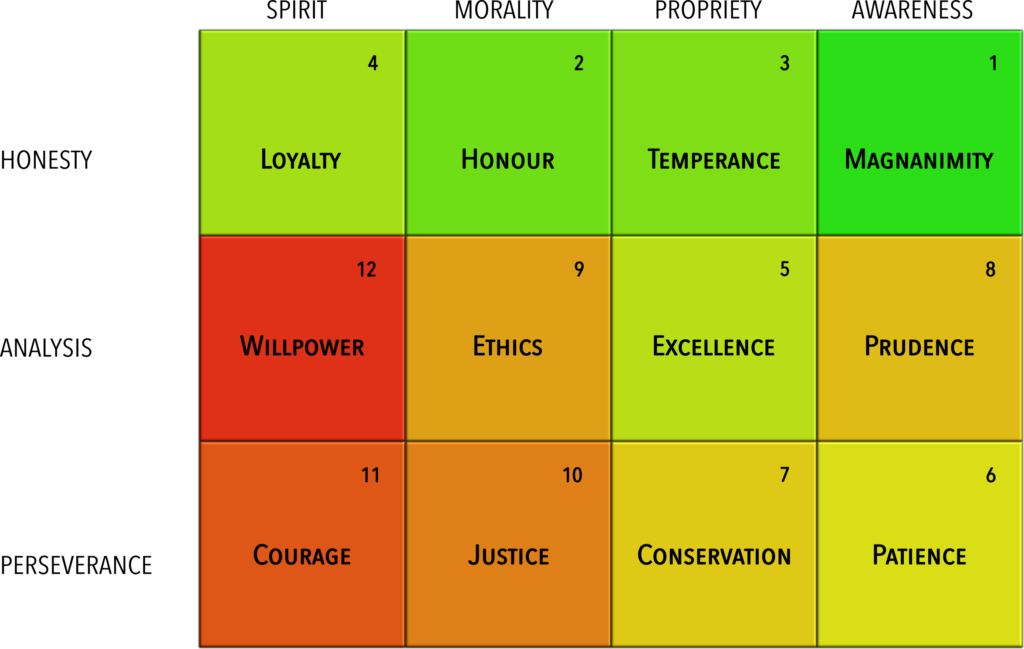
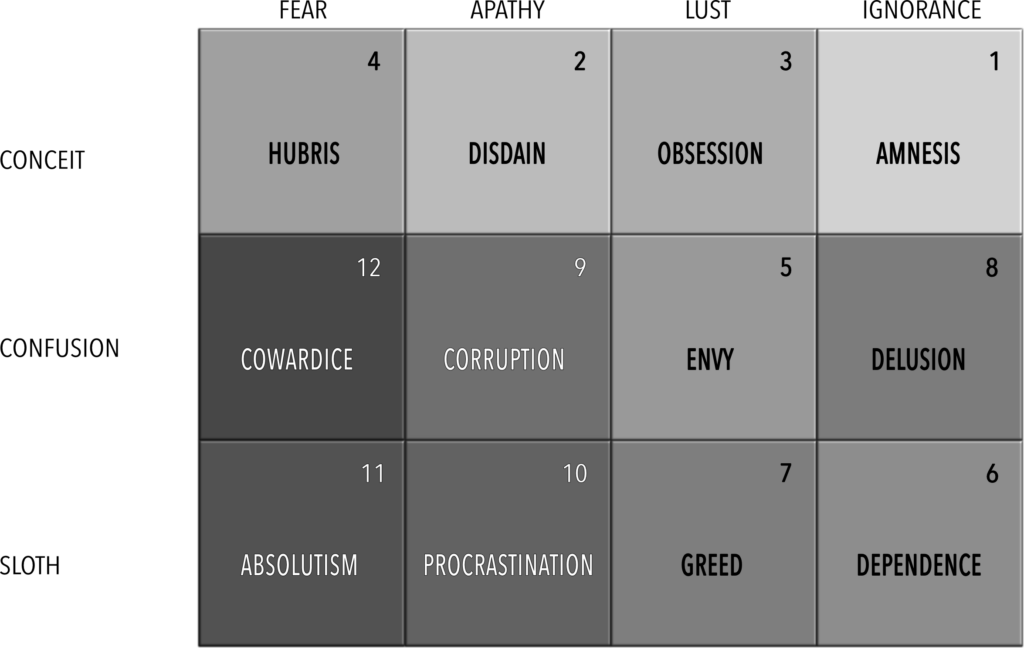
Lawlessness drives the need for law, but then law constructs trust, fulfilled or not determining memetic longevity or loss. In Structural Virtues Theory (SVT), Procrastination appears in the Apathy moment of the Sloth aspect of Materiality, where the soul clings to illusions of a betterment without ever working out understandings of the present and past. This sin operates against the Logos domain enhancements of Eros domain, which demand disciplined denial of the lower self and the reconfiguration of ego through charity. Procrastination is an erosion thriving on illusions in categories of mortal infiniteness.
Institutionalisation of Procrastination: Lazy Rebellion Against Limits in Time and Logic
This sin manifests as a labyrinth of delayed Justice, Moral evasion, and institutional complicity. As one corrupt character asks in response to concerns about the Ethics at play, “I gotta tell you how we pay the rent?” The film’s eponymous protagonist, Michael Clayton, is a “fixer” for the lawfirm. His role is to clean up scandals, manage crises, and protect wealthy, corrupt clients; postponing or burying ethical confrontations indefinitely through conniving legal manoeuvring, payoffs, intimidation, and PR spins. This is moral numbness as a survival tactic in a world rigged against truth.
This cycle is systemic and not particular to Clayton. His lawfirm is deeply complicit with U/North, a conglomerate that has exploited thousands of lives through its toxic weed killer. Procrastination here is the soul’s submission to greed, where the individual’s moral compass becomes drowned out by the clamour of self-preservation in institutional inertia. Michael’s Procrastination (as replicated by others) enables greater corruption, while his delusions allow him to believe he is not complicit in the crimes or the shape of the corrupt organisation.
Repeating here but it is important, Procrastination stems from Apathy in Sloth, a state where the soul retreats into self-deceptions, believing that the future will somehow correct itself just as well regardless of or without any action on ones own part. In SVT, this sin is destroyed by the virtue of Ethics which precedes Justice, residing in the Analysis aspect sandwiched between Honour’s and Justice’s own Morality moments. The analytical morality in Ethics is what destroys Procrastination; thus setting us up for further development in the Justice virtue, which is the opposite of Procrastination.
Ethics demands fairness, stability, and the creation of just systems, while Procrastination is conquered by engaging with the present as it could be, breaking the cycles of regret, frustration, and further inaction. Ethics requires responsibility: acknowledging that our actions shape the world and that delaying Justice only deepens injustice. Patience, Conservation, and Prudence, the preceding virtues, allow us to accept delays without despair and give those delays purpose, most especially in Ethics, as the groundwork of the Justice to come with the downfall of Procrastination. Clayton embodies this described tension between Ethics and Procrastination, as he navigates a world where truth is buried under grotesque layers of Greed, Delusion, and bureaucratic stagnation. His journey reflects the SVT aftermath of Procrastination through the cultivation of Ethics leading to Justice and then Courage, while confronting the systemic Corruption that stifles just action.
The Ethical Morality on grounds of Prudence and Excellence is reinforced by the great earthenworks of virtues in the aspects spanning Honesty and Perseverance, a stark contrast to Procrastination’s refusal to act in the present. No, Procrastination cannot possibly stand against such true Ethics. It gives way to actual Justice regardless, whether we are on its side or not. The movie perfectly illustrates this transformative moment in the interchange Clayton begins: “I’m not the enemy.” “Then who are you?” he is asked. Clayton doesn’t answer this question until the end of the film.
Delusion of Separation and Delusional Delay
In SVT, Procrastination is fuelled by Apathy: carelessness regarding actual failures and an arbitrary outlook on success that forego legitimate Prudence and Conservation. It is a sin that feeds on delusions in needs, resources, and limits, but in reality, it erodes all virtues if allowed to continue, especially societally. Without ethics, the individual cannot progress toward Justice, which is essential for expansions in righteous actions.
Michael’s delusions are a perfect illustration of this. He tells himself that he is separate from the evil he enables, that his role as a fixer is not inherently corrupt because it is just a job and somebody is going to do it. The Delusional Corruption in Procrastination allows him to mentally avoid the inevitable moral reckoning that would require him to choose between his career and his safety, or the lives he has helped destroy.
Clayton’s career is a study in this struggling through Materialism and juggling lies to stay just out of reach of Justice’s axe, while deluding himself to his actual role in the bigger picture. As a fixer, he relies on this Delusion of separation: he rationalises his role as “just doing my job,” reflected by the others in the film all around, maintaining a veneer of detached competence, and clinging to the idea that he is not really part of the evil, he is the guy who manages it in “doing what he needs to” in order “to survive.” In the end he is not doing what he needs to do, but managing a collection of Delusions constructed about those needs.
His Delusions are a form of Procrastination, a refusal to acknowledge the moral cost of his actions in favour of immediate profit, at first, then comfort, and finally for his survival itself, mounting with the depths in the sin. His Procrastination fuels the Corruption without him ever knowing it, as blind, allowing Greed to flourish unchecked. The agro-chemical company (U/North) knowingly poisoned people and lied about it for years, while the actors (all in common positions as Clayton) in the film all ensured truth was buried, delayed, or manipulated into silence.
Delusion is further mirrored in the film’s portrayal of Mr. Edens, the whistleblowing senior partner who begins to have an Ethical awakening after years of complicity. Edens’s breakdown during a deposition, his refusal to seek help, and his eventual murder by U/North operatives symbolise the breaking point of Procrastination through the bare blatancy of unethical actions. The faked suicide forces Clayton to confront the monster he has helped sustain, but it is only then that he can no longer Procrastinate: almost too late now, he must choose between silence and Truth.
In the film’s central explosive scene upon which all else turns where he was supposed to die in a car bomb, Clayton approaches three horses standing at the top of a hill near leafless trees. This is highly metaphoric. The imagery symbolises the soul’s paralysis as the horses of needy Materialism in the thin of barren trees as the spiritual desolation in effect due to inaction: Procrastination. The bomb in his car, detonating as he approaches the horses, is a very real consequence of delay brought on by these Material forces dragging us down in our need, rather than allowing the light to shine. Seeing the horses and walking towards them represents his soul saving him by means of reflection: showing his Materialist “needs,” the excuses he uses for Procrastination, are artificially constructed and there is nothing of the sort holding him back as he’s imagined. He sees the horses for what they are now, and he sees the Delusions and Greed clearly as simple Materialism, and so now he knows it is Patience, Conservation, and Prudence that stop them. The horses of our needs are what we make them to be, outside of our very basic human requirements. The horses on the barren hill run away at the explosion, which represents the destruction of his Delusions.
This Delusional delay in artificial needs and Corruptive false ego are where Procrastination expands on the twining illusions of infinite time, tolerance, or other resources variously; Delusions left unchecked erode the virtues in the remixing of memory and time, as alloying greater depths of sin/Materiality. Clayton’s job as a “fixer” represents what people do individually with their past, in scrubbing away incriminating truth through Amnesis, yet he does it for big faceless interests of Greed on societal levels: that’s what the deepest level of sin in Cowardice enables around the sinners, it allows others to forget, making the connection between Cowardice and Amnesis as communal as the connection between Willpower and Magnanimity. Every time he partakes in these lies, he knows it’s a gamble, but Clayton is a gambler. This is that Corruption stemming from Delusion, guaranteeing the onset of paralysing Procrastination. Clayton’s moment of spiritual salvation in this pivotal scene of those horses on the hill, of a delusional peace violently interrupted, presents society’s awakening itself.
Procrastination in Community: The Need for Ethical Discernment Against Ubiquity of Delay and its Cost
U/North’s CEO Don Jeffries and his general counsel Karen Crowder orchestrate a cover-up that spans years. They use legal loopholes, payoffs, and intimidation to silence whistleblowers, like Mr. Edens their former representation. Clayton’s role as a fixer ensures that these actions are delayed indefinitely, allowing the sinners within the corporation to avoid accountability.
In SVT, Procrastination thrives on collective inaction. When individuals avoid taking responsibility for their part in a shared communal project, others are emboldened to follow suit, creating cultures of complacency wherein Stockholm rigidity in Absolutist and absurd notions take hold. Overcoming this requires the cultivation of Ethics within individuals and the reinforcement of shared values that prioritise accountability and expectation over profit or comfort.
Any balance between ego and charity is marred in the ultimate worship of the lower self. This is represented most by Clayton’s willingness to circumvent Ethics for what he has been convinced, what he has convinced himself, means his survival, just as the law firm attached itself to a corrupt corporation out of needs. Greed and moral bankruptcy have systematically graduated into the larger patterns of institution, where Material gain supersedes Justice.
Clayton’s decision to expose his firm’s complicity in poisoning people through an agro-chemical company (U-North), is the act of Courage through Justice as final step in burying the sin, even after decades of so many links in the chain falling to Procrastination due to Delusion and Greed. Clayton’s actions are a personal resolution built upon a larger and selfless communal reckoning. By choosing to act, he breaks the societal cycle of Procrastination and Corruption that has allowed lawlessness to rule in his firm and society at large. Michael confronting Crowder underscores this dynamic. He recognises that his delay in acting had enabled the suffering of others, and he chooses to confront that truth even at great personal cost, yet speaking the language of Crowder in getting her to reveal the truth because he was in her same position very recently: blinded through Delusional “needs.”
Crowder, representing the firm’s false Ethical facade, agrees to $10 million for Clayton’s silence, a transaction that epitomises the commodification of Justice as stable antagonist throughout the film. In the end, Crowder and U/North are not conquered, but the dragon of Corruption which swallowed them is. Clayton answers the question posed to him by his late acquaintance, Mr. Edens, earlier, by saying “I’m Shiva bringer of death.” This is an admission of his sins and his demonic actions throughout his career, but moreso, his role in bringing U/North and all the corruption, including his own, to an end. Some might argue that this is a hidden reference to our Apostle’s death to the world, upon being crucified with the Lord. To die to the world is not about dying to the people in it or their real needs, but to the false desires and Delusional needs: losing interest in the goals of most people in it anyway.
Conclusion: The Reckoning of Delay
Procrastination is a destructive power in a world where Greed, Delusion, and inertia of institutionalised Corruption threaten to erase Truth itself. Through Clayton’s journey from complicity to confrontation, the film illustrates how Procrastination can be overcome through Ethics, Justice, Courage, and Willpower, even when the cost is great. It is a reminder that the soul’s deepest struggle is not with external forces but with its own capacity for delay, denial, and self-deception. In the end, the only way to transcend Procrastination is to act, not out of fear or some false sense of obligation, but out of a commitment to Truth, Justice, and the greatest Good we can instantiate.