A Christian Philosopher’s Take on Batman Versus Joker
In the sprawling metropolis of Gotham, teetering on the brink of chaos, we find ourselves confronted with a moral conundrum as old as humanity itself. The Dark Knight is a philosophy film cloaked in the garb of cartoonish comic book heroism. It invites us to ponder the nature of Honour, that elusive virtue which, when cultivated, elevates the soul from the muck of moral relativism and gives us a broader perspective on our place in the wider world. Honour, within Structural Virtues Theory (SVT), is the second virtue, emerging from Honesty aspect of reason applied to the Morality moment. It is the recognition of intrinsic worth, not merely in oneself but in others, and the commitment to act in accordance with that recognition. This is no facile matter of chivalry or mere social decorum; it is the bedrock upon which ethical clarity is built, and all ethical arguments are made. This is the only source of the Loyalty, Ethics, and Justice requisite for legitimate Courage and godly Willpower.
The Telos of Gotham
Gotham City is a microcosm of societal decay, where the lines between hero and villain blur like ink in a night of rain. It is within this moral fog that Batman operates. I normally do not even watch the so-called “superhero” genre of movies but something is different about Batman, especially those versions with struggles related to the most interesting characteristics of this mortal vigilante, empowered by a gross parasitism he himself cannot see. His is a story of encroaching darkness, growing blindness, both literal and metaphorical, and yet he is completely blind to his own. The universe in which these criminals live is admittedly cartoonish, and the motives of many thus necessarily unrealistic, especially the arch-villains. Their lack of verisimilitude however is necessary to align to the blindness of the bat-man, the blind man, made more than mortal through money, somehow legitimised for the audience by the deaths of his parents and the actions he takes with it. There are many things I could relate this to, as it plays upon human universals.
Batman’s journey, albeit corruptions of truth inherent, can be contrasted against the Telos domain of Resurrexit Spiritus (RS), where everyone balances product (the outcome) with their craft (the process) in terms of goals. In Batman’s case, the product is always his brand of justice, while the craft is in his machine-empowered martial abilities (gloss quietly accepted and presumed as part of our norms) and strict moral code (constantly reaffirmed and glorified). Laudable? Perhaps in one light. This domain of goals in Telos demands that we reconcile our actions with our principles. The onset of greater balance in the preceding (Kratos) or proceeding (Eros) domains due to Logos residence ensures the means do not corrupt the ends and the ends represent our highest moral ideals.
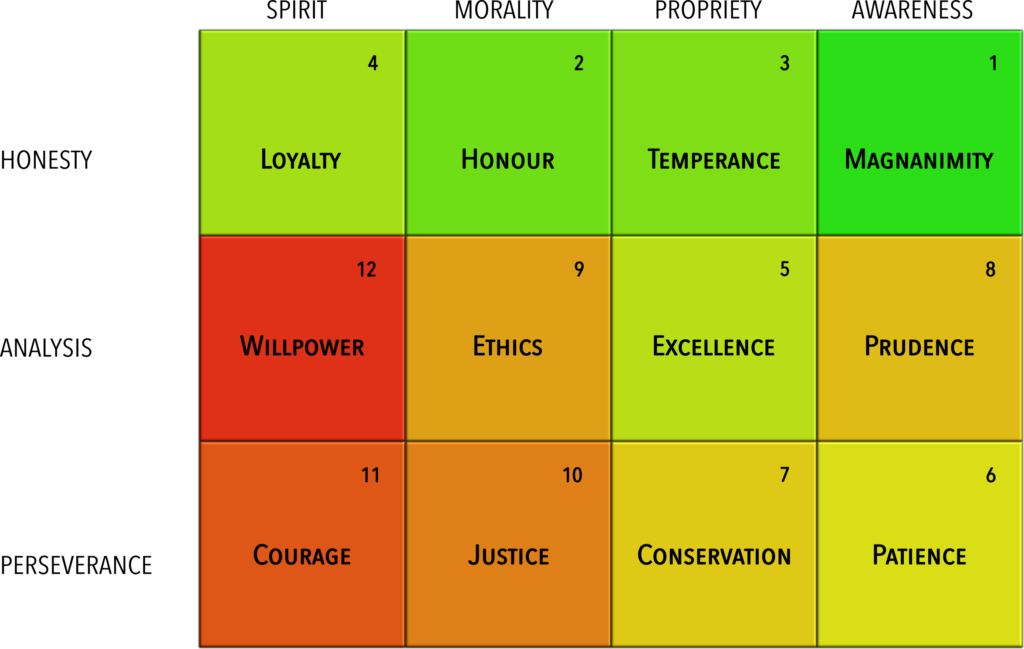
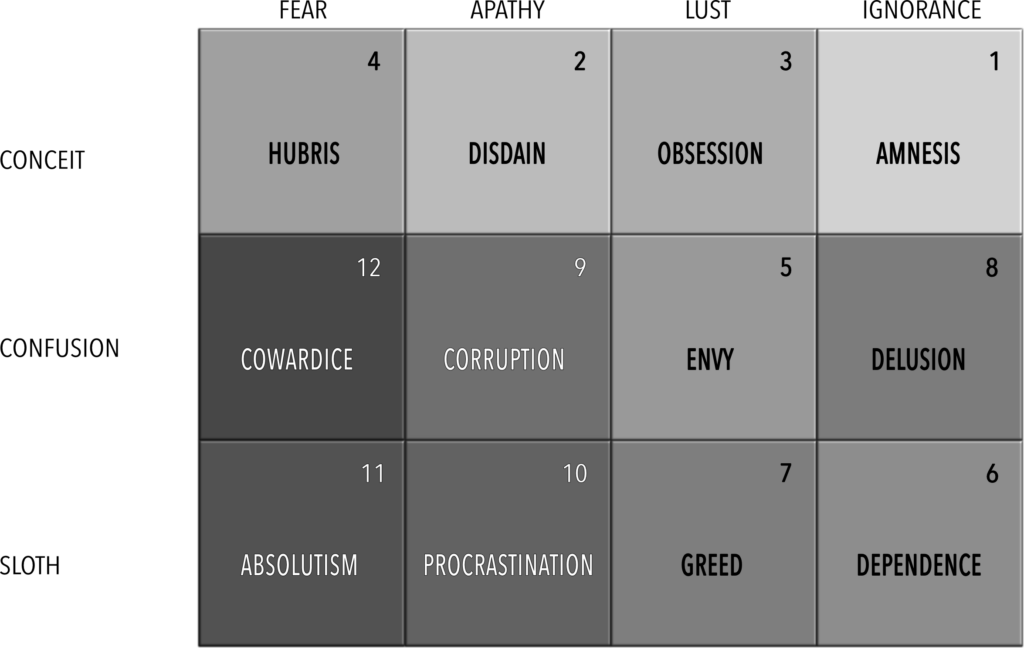
The blind man’s refusal to kill Joker, the mad man, despite the immense provocation, exemplifies this struggle of aligning means and ends, but, as stated before, that refusal mirrors his inability to look within and judge his own actions on the grander scale, along the lines of his unnatural business dominance. Choosing to save the mad man’s life multiple times is meant to portray stark ethical clarity amidst the chaos, a testament to Honesty applied to the moment of Morality. He recognises the inherent worth in every life, even those twisted by malice. This plays upon recognition as the essence of Honour which validates its own divinity: seeing through to the divine spark within the enemy despite the depravity. The blind man succeeds to a great degree through to Temperance, Loyalty, Excellence, and Patience, but fails at Conservation and Prudence in acting out incorrectly, which correlates with his struggles in Greed and Delusion (which happen to be at the same places on the sin chart as Conservation and Prudence are on the virtues chart). His utter failures, therefore, in Ethics and Justice due to Greed and Delusion belie his sins of Corruption and Procrastination. Of course, his apparent inordinate Courage for a falsely arranged Justice is for nothing, nihilist and without God, missing the humility of submitting to His will: Willpower.
The Mad Man Disdainful Mirror to the Blind Man’s Greed and Delusion
The mad man is the blind man’s funny mirror, antithesis, and moral foil, because they are manifestations of the same basic confusion blocking true Prudence, Ethics, and Willpower. This mad man embodies the sin of Disdain, the abandonment of ethical responsibility, but of course this is based in the internalisation (weight) of the sins above it, since the sins work in the opposite direction from virtues. He sees life as a jest, a meaningless farce where actions have no consequence beyond immediate gratification, since anyone can seemingly take anything from anyone, and he hates those with plans the most, since they make the most movement. His nihilistic worldview is a perverse reflection of the amoral chaos that threatens to consume Gotham. However we are starting to see where the two ostensibly opposite perspectives of the blind man and the mad man are actually quite the same.
In fact, it appears as though there is a certain Jekyll and Hyde situation going on here, because the mad man’s overt goals are not actually distorting the blind man’s chosen blindness regarding his own actions. This goes so far as having the mad man compliment, throw out a window, and then actually kill the blind man’s ex (Rachel) who refuses to accept what the blind man views as his own truer identity, the deepest of rejections possible (unless of course it was simply the most convenient excuse and she just didn’t like the way he chewed his food). There is great truth in the results of Rachel’s preference for the blind-&-mad-man in Two-Face’s previous identity of Dent (who is stuck on Envy despite demonstrating some mastery in Loyalty), revealing Dent’s dedication to justice as false and merely for the show, or what it can get him in life (the wife/situation he wants) where the blind man would choose justice, as flawed as his Ethics underlying it might be in the larger picture.
The mad man’s ideology is anarchy founded in disdain against the very concept of machination and organisation, seeing all of it as entrapment. So his goals are to bring down the biggest organisers, on all sides. He mocks the blind man’s principles, daring him to cross the line into murder. Yet, the blind man holds fast, believing that doing so would be giving into what he fights against. This has all the working parts of Honour yet falls short at Temperance and Loyalty, due to yet more unspoken conventions simply accepted within society, such as absurdly corrupt views of Ethics which disarm Justice and true Courage for slave-oriented appeasements to unrighteous monopolies on violence. The answer, of course, is not slavery or anarchy, obviously, but this is the dichotomy presented. We laugh at the accountant who threatened exposing the blind man but his fear was very real. Of course everything makes sense if we recognise this is all going on in the mind of a single individual contending internally with a lot of pain and conceiving of a satisfying theodicy, with the blind man’s Ethics being one even he does not quite understand the purpose of as he continues in his impenetrable materialism.
The Moral Tightrope
This tension of false dichotomy between moral absolutism and relativism is the major theme of the film, resonating deeply with SVT’s emphasis on Honour as a virtue rooted in Honesty and Morality. The blind man’s code is absolute: no killing, no matter the circumstance. The mad man’s is simpler: destroy anything functional. Gotham demands more than abstract principles; it requires action. The blind man navigates the moral tightrope of his own construction, balancing his unwavering code with the dire needs of the city, yet wholly missing how he contributes to that need and how business actions of corporate monopoly parasitically destroys all function outside the organisation. This is the essence of a perfected Telos: crafting justice through moral clarity in Logos residence. It is a delicate dance, one misstep could send one spiralling into the abyss of Dependence, Envy, Hubris, Obsession, and Disdain, for which the Greed and Delusion displayed by the blind man sets us up for madness.
The Weight of Truth
Honour, as articulated by SVT, is an ever active virtue founded and strengthened in identity, demanding engagement with the world, and a willingness to act in accordance with our deepest ethical convictions. The blind man does not retreat into cynicism nor despair but confronts the darkness, guided by his moral compass. If only he had applied this same tenacity internally, he would find better ways of seeking after a more righteous Justice. Active Honour is what sets the blind man apart from the mad man. While the clown prince of crime revels in chaos, the blind man seeks order even if he cannot see it all, and this is laudable. He should have pressed this further, and sought greater internal alignment. His refusal to kill the mad man is a sign of corruption and misguided strength stemming from confusion in Justice and his own role in it. The goal in strength is in enabling meekness, not weakness, so where the blind man’s usual conviction to a moral code, gets dragged down into Absolutism, number 11 on the sin chart above next to Cowardice, countered by Courage and Willpower
The blind man’s refusal to make an executive decision in terms of Justice is disabling and leads to the death of innocent people, most poignantly Rachel Dawes and Harvey Dent’s descent into Two-Face, stumbling those not as advanced in terms of virtues. This is identical with not crucifying the lower self, seen in his blindness to all consequences of his life and business. His sense of Honour and identity were founded upon false notions which disabled his ability to act at critical moments. He denies himself the only dominion granted him righteously by God, immanently and within. These tragedies underscore the complexity of Honour within the Telos domain. Honour then is not a panacea but can appear as a double-edged sword when we are lacking in other virtues, tying us to dangerous ideas that limit the good we can do. The blind man’s primary struggle has to do with the internal conflict between his principles and his idea of self as warped by an amoral society promoting false notions of morality which disable Justice, Courage, and Willpower. This is the weight of truth amidst the storm of moral relativism, it will not be understood and will be condemned despite all its good. Stand firm in the light of truth, even when the night seems endless.